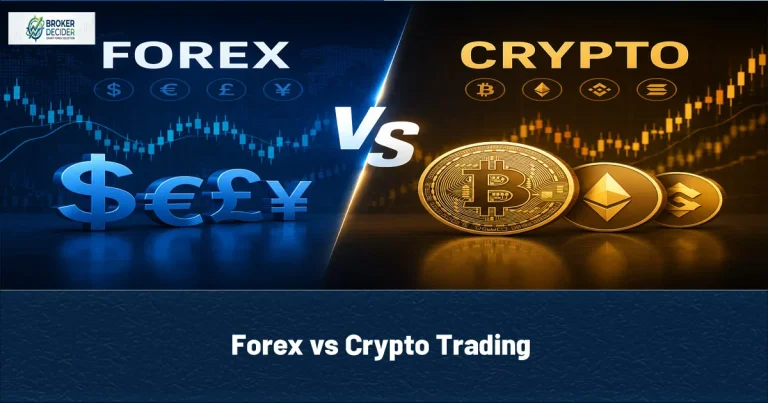
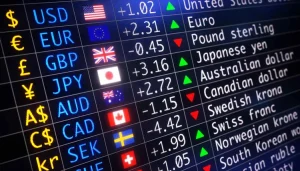
Forex vs Crypto Trading. What is the difference? Forex is the global market for trading national currencies against each other (Like EUR/USD, GBP/JPY, USD/CAD, and so on). It is the world’s largest financial market, processing roughly $9.6 trillion in average daily volume. It operates as a decentralized market.
Crypto trading involves buying and selling digital assets like Bitcoin, Ethereum, and thousands of smaller tokens on blockchain typically through centralized or decentralized exchanges. The total crypto spot market processes somewhere between $80 and $150 billion daily, with Bitcoin alone often accounting for $20–40 billion of that. It is meaningfully smaller than forex by total volume.
Read More: Forex Backtesting Guide
Side-by-Side Comparison of Forex vs Crypto
| feature | Forex | Crypto |
| Typical Daily Move | 0.5% to 1% | 3% to 5% for BTC/ETH and 10 to 20% for smaller tokens |
| Main Price Drivers | Interest rates, GDP, inflation | Adoption, tech upgrades, sentiment |
| Daily Volume | About $9.6 trillion | About $80–150 billion |
| Custody Risk | Funds held with regulated broker | Self-custody |
| Trading Hours | 24 hours, 5 days a week | 24 hours, 7 days a week |
| Cost Structure | Spread-based | Flat-fee/commission |
| Market Structure | Decentralized | Blockchain-based |
| Regulation | FCA, CFTC, ASIC, CySEC, etc. | Varies by exchange |
Forex vs Crypto Trading; Volatility
This is the single biggest practical difference between the two markets, and it’s worth understanding properly because it cascades into almost every other decision you’ll make. Major forex pairs like EUR/USD typically move 0.5% to 1% in a normal trading day. Bitcoin and Ethereum routinely move 3% to 5% in a single day, with double-digit swings common during strong trends or major news. Smaller, less liquid tokens can move 10–20% within a matter of hours.
Read More: Forex Fundamental Analysis
Forex vs Crypto Trading; Regulation
Forex brokers operate under established regulatory regimes like the FCA in the UK, the CFTC and NFA in the US, ASIC in Australia, CySEC in Cyprus. These frameworks mandate segregated client funds, capital requirements, and in many cases investor compensation schemes if a broker fails.
Crypto regulation varies sharply by exchange, by country, and frankly by how recently a given jurisdiction has gotten around to addressing digital assets at all. Some exchanges now publish proof-of-reserves and maintain protection funds; others have collapsed overnight, taking client funds with them, with considerably less recourse available than a forex trader would have if a regulated broker failed.
Forex vs Crypto Trading; What Moves Each Market
In forex, price action is driven by central bank interest rate decisions, inflation data, employment reports, GDP growth, and the broader interplay between national economies. In crypto, the drivers are network adoption trends, protocol upgrades, regulatory headlines, large-holder activity, and a considerable amount of pure sentiment and narrative.

Read More: USD/JPY Forecast 2026: Outlook, Predictions, Key Drivers, and Trading Opportunities
Forex vs Crypto Trading; Costs and Taxes
Forex costs are typically built into the spread, often with no separate visible commission. Crypto exchanges tend to use more transparent flat-fee commission structures, which can range from under 0.1% on competitive exchanges to considerably more on retail-friendly platforms.
Final Thoughts about Forex vs Crypto Trading
The forex vs crypto trading debate doesn’t really resolve into a single winner. Forex offers depth, regulatory maturity, and a more predictable rhythm. On the other hand, Crypto offers round-the-clock access and sharper trends. The right choice is the one that matches your own capital, risk tolerance, and the kind of attention you’re actually willing to give a market.
Read More: The Best Forex Brokers in Pakistan 2026
Source: Investopedia