What is order block? If you’ve spent any time around ICT trading or Smart Money Concepts, you’ve almost certainly run into the term order block. This article breaks down what an order block actually is and why it forms.
What is order blocks?
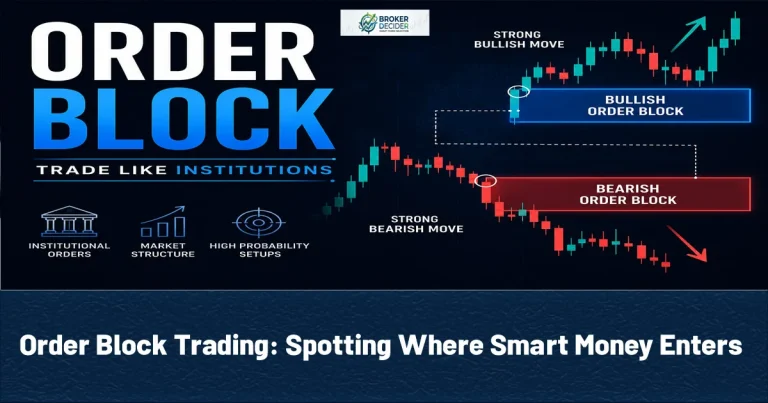
Strip away the jargon and an order block is just a specific candle or small cluster of candles that marks where a large player is thought to have entered a sizeable position right before price took off in one direction. It’s not a support or resistance line in the classic sense. It’s more like a leftover footprint of institutional buying or selling that the market sometimes comes back to test. That last part matters. Price doesn’t always return to an order block, and even when it does, there’s no guarantee it reacts the way you’d hope. Order blocks describe probability zones, not certainties, and keeping that distinction in mind will save you a lot of frustration down the road.
How an Order Blocks Actually Forms
The formation pattern of Order blocks is fairly consistent once you know what to look for:
- Price stalls or chops sideways for a while.
- Orders build up quietly during that pause.
- A sharp, one-directional move breaks out.
- The last candle in the opposite direction, right before that breakout, becomes the order block.
Bullish Order Blocks
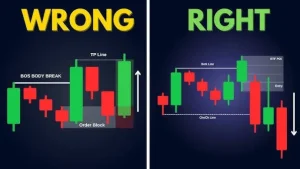
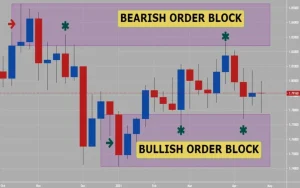
A bullish order block is the last down candle before price rips higher. Traders keep an eye on this zone because if price pulls back into it later, there’s a reasonable argument that buying interest could resurface there. That said, plenty of experienced traders won’t touch a long entry off a bullish order block without something else confirming it first, like a shift in market structure or a liquidity sweep just below the zone.
Bearish Order Blocks
Flip it around and you get the bearish version: the final up candle right before a strong sell-off. When price retraces back up into that zone, some traders watch for signs of renewed selling pressure before considering a short. Again, the zone alone isn’t the trigger, it’s the starting point for a closer look.
Order Blocks vs. Supply and Demand
Traditional supply and demand trading tends to draw broader zones based on where price previously reversed sharply, without necessarily tying that to institutional order flow specifically. By contrast, Order blocks theory zeroes in on a much narrower area and frames it explicitly around the idea of large-player accumulation.
| Aspect | Order Blocks | Supply & Demand |
| Origin | ICT / Smart Money Concepts | Classic price action |
| Precision | Narrow, often one candle | Broader zone |
| Framework | Tied to institutional order flow | Tied to buyer/seller imbalance |
| Typical pairing | Liquidity, FVG, structure shifts | Often used on its own |
Order Blocks and Fair Value Gaps
You’ll often notice an order block sitting right next to a Fair Value Gap (FVG), and that’s not a coincidence. The order block marks where institutional entry likely occurred; the FVG marks the imbalance left behind by the speed of the subsequent move. When both line up in the same area, a lot of ICT-style traders treat that overlap as a stronger signal than either concept alone would provide.
Framework for Spotting Order Blocks
Rather than staring at a chart hoping something jumps out, it helps to work through this in order:
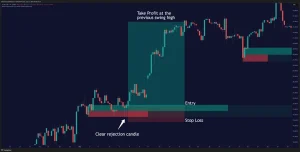
- Step 1: Find real momentum. Look for a clean, impulsive move that actually breaks prior structure. overlapping candles rarely produce a reliable order block.
- Step 2: Mark the last opposite candle. That final down candle before an up-move (or up candle before a down-move) is your candidate zone.
- Step 3: Let price come to you. Chasing the move after it’s already happened is a common beginner mistake. Patience here tends to pay off more than speed.
- Step 4: Wait for confirmation. This is the step people skip most often. Useful confirmation signals include a liquidity sweep, a break of structure (BOS), a change of character (CHOCH), an overlapping FVG, or a strong rejection wick.
Advantages of Order Blocks
Advantages of Order Blocks are:
- Narrowing down where to look for entries instead of guessing
- Tightening stop-loss placement, which improves risk-to-reward
- Getting a rough read on institutional behavior in a given range
- Layering them with other ICT tools for a fuller picture
- Avoiding impulsive entries by waiting for price to come back to a defined zone
Order Blocks Rarely Work Alone in ICT Trading
Within ICT methodology, order blocks are almost never used in isolation. They’re typically read alongside market structure, liquidity pools, liquidity sweeps, Fair Value Gaps, and premium/discount pricing. The general rule of thumb is straightforward: the more of these elements that stack up in the same zone, the more weight traders tend to give the setup.
Mistakes in using Order Blocks
Mistakes in using Order Blocks are:
- Trading every single order block they see
- Ignoring the higher timeframe
- Jumping in the instant price touches the zone
- Overlooking liquidity entirely
Final Thoughts about Order Blocks
An order block is a good and useful lens for understanding where institutional activity may have shaped price, but it was never meant to function as a standalone trading signal. The traders who get consistent value out of this concept are the ones who combine it with liquidity, structure, Fair Value Gaps, and solid confirmation.
Recommended Brokers for Forex Trading
These brokers can be suitable for forex trading. However, you should always take the risks of trading into consideration.
Sign Up with Errante Sign Up with Orbex Sign Up with HYCM
Source: Investopedia