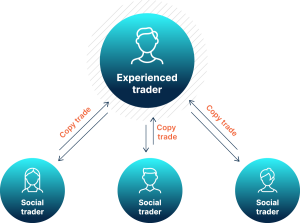
Forex copy trading is a system that automatically mirrors another trader’s positions into your own account — in real time, proportionally sized to your balance. When the trader you’re following opens a buy on EUR/USD, the same trade opens in your account. When they close it, yours closes too. You don’t approve anything manually. You set it up once and the platform handles execution.
The concept has been around since roughly 2010, when eToro pioneered it as “social trading” for retail investors. By 2026, it’s a mature, well-regulated feature offered by most major forex brokers — and the infrastructure behind it is far more reliable than it was in the early days, when latency issues could mean your copy arrived seconds after the original at a significantly worse price.
One distinction worth making clear: copy trading is not the same as social trading. Social trading means you can see what other people are doing and choose to replicate it manually. Copy trading is fully automated. The moment the signal fires, your position opens. There’s no delay, no approval, no decision on your part after the initial setup.
Read More: Forex Risk Management; The Complete Framework for Protecting Your Trading Capital
Who Is Forex Copy Trading Actually For?
This is a question that most guides skip entirely, which is a mistake. Copy trading is not for everyone — and being honest about that saves people money. It tends to work well for three types of traders:
| No. | Who Is Forex Copy Trading Actually For? |
| 1 | Beginners who want market exposure while learning |
| 2 | Time-constrained traders |
| 3 | Portfolio diversifiers |
Copy trading is a poor fit for anyone who expects it to be passive income with minimal involvement. Monitoring your chosen traders, adjusting allocation when performance deteriorates, and managing overall account risk are all active responsibilities — even when you’re not placing trades yourself.
Forex Copy Trading Platforms in 2026: What to Look For Before You Choose
The platform you choose matters far more than most beginners realize. A good copy trading infrastructure handles execution at near-zero latency, offers transparent performance data on strategy providers, and gives you meaningful control over risk settings. A poor one obscures fees, shows cherry-picked statistics, and pairs you with traders who built their track record in a demo environment. Four criteria separate the platforms worth using from those that aren’t:
- Execution Speed and Latency: When you copy a trade, time matters. A 2–3 second delay on a fast-moving forex pair can mean your entry is 10–20 pips worse than the original. The best platforms execute copies at under 100 milliseconds. This is worth checking on community forums before depositing, because no broker advertises their latency honestly in marketing material.
- Trader Transparency and Verified Statistics: Any platform can display a profit chart. What you need is verified drawdown history, consistency metrics over +12 months, trade frequency, and maximum single-trade loss. A trader showing 200% annual returns with a maximum drawdown of 50% is not a safe follow — they’re one bad month away from wiping half your allocated capital. Platforms like ZuluTrade and DupliTrade show this data clearly. Some others bury it.
- Risk Control Tools: You need the ability to set a maximum drawdown limit per copied trader — a hard stop that automatically stops copying if losses reach a defined threshold. Without this, you are entirely dependent on the trader’s own risk management, which is a significant exposure. Most reputable platforms in 2026 offer this. If a platform doesn’t, that tells you something important about how they think about your capital.
- Regulation and Fund Safety: eToro (CySEC, FCA, ASIC regulated), Pepperstone (FCA, ASIC, CMA regulated), and AvaTrade (Central Bank of Ireland, ASIC, FSA regulated) are among the most heavily regulated options in 2026. Regulation does not guarantee you’ll make money — but it does mean your funds are segregated from the broker’s operating capital and subject to independent audit. For a feature like copy trading, where you’re already delegating trading decisions, using a regulated broker is non-negotiable.
Read More: Best Forex Trading Strategies: A Practical Guide for Consistent Traders in 2026
Best Forex Copy Trading Platforms in 2026: Quick Comparison
| Copy Trading Platforms | Min. Deposit | Assets | Best For | Key Advantage |
| eToro | $50 | Stocks, Forex, Crypto | Beginner | Largest network (35M+ users); CySEC & FCA regulated |
| ZuluTrade | $300 | Forex, Indices, Crypto | Intermediate | Deep analytics; works with multiple brokers via MT4/MT5 |
| HYCM | $20 | Stocks, Forex, Crypto | All levels | Deep analytics |
| Pepperstone | $200 | Forex, CFDs | All levels | Low spreads; Ctrader Copy natively built in |
| AvaTrade | $100 | Forex, CFDs, Crypto | All levels | DupliTrade & ZuluTrade integrated; strong regulation |
How to Choose a Trader to Copy: The Criteria That Actually Matter
This is where most people go wrong. They sort by “highest return” and pick whoever is at the top of the list. That trader is almost always the one taking the most risk — and frequently the one who will hand back all those gains (plus your capital) within the next few months. Here is the framework that experienced copy traders use instead:
- Track record of at least 12 months — not 3, not 6. Market cycles matter.
- Maximum drawdown under 25%. Anything higher means survival depends on luck.
- Win rate between 45–65%. Below 40% requires exceptional R:R to be sustainable.
- Consistent monthly returns, not volatile spikes. 3–8% monthly is realistic. 30%+ is a red flag.
- No open trades held indefinitely. Traders who never close losers are hiding losses, not managing them.
- Reasonable leverage use. Strategies consistently running 1:50+ are high-risk by design.
Diversifying across three to five traders with different styles — one trend follower, one range trader, one fundamentals-driven — reduces your exposure to any single strategy underperforming during a specific market phase.

Read More: Price Action Forex Trading
The Honest Risks of Forex Copy Trading
There are things that can go wrong with copy trading that you won’t read about in platform marketing materials, but that experienced traders discuss openly:
- Past performance is genuinely not indicative of future results: A trader who made 80% in 2024 may have done so in trending conditions that no longer exist. Their strategy may be entirely wrong for current market structure.
- You can lose money even when the trader is profitable: If your account is small relative to the trader’s, proportional scaling can create rounding issues that systematically disadvantage you on entry prices.
- Slippage accumulates: Even a 1-pip average slippage on every copied trade, across 200+ trades per year, represents a meaningful drag on returns — particularly on a small account.
- Traders change their behavior after gaining followers: A trader managing their own $10,000 account takes risks differently than one managing $2 million in copied capital. Risk appetite often shifts. Performance data from before they had significant followers may not predict how they trade now.
Conclusion: Forex Copy Trading
Forex copy trading in 2026 is a legitimate tool — not a passive income machine, not a scam, and not a shortcut to professional-level returns. What it is, when used properly, is a way to access skilled trading execution without doing the analysis yourself. That’s a real value proposition for the right person. The key word is properly. Choosing traders based on verified long-term data, diversifying across multiple strategies, setting drawdown limits, and monitoring performance monthly — these are not optional extras. They are the difference between copy trading that builds an account and copy trading that drains one.
Read More: XAUUSD Trading in 2026
Source: Investopedia