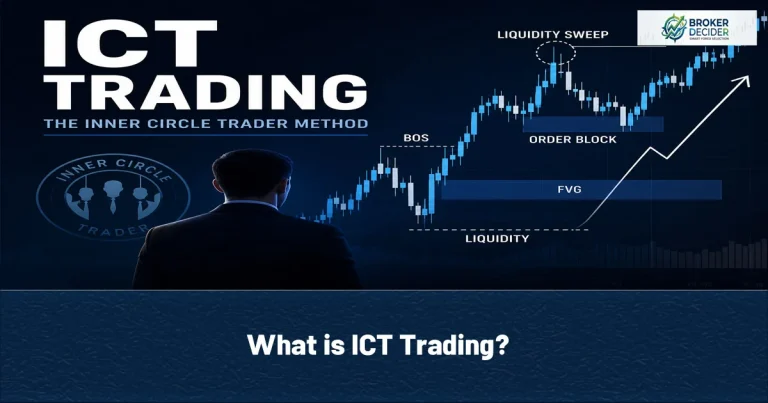
ICT Trading is an approach for reading financial markets, drawing a growing following among Forex traders and beyond. ICT Trading developed by Michael J. Huddleston, better known as the Inner Circle Trader (ICT). This methodology moves away from lagging indicators and instead builds its analysis around liquidity, market structure, and raw price action.
Read More: What Is Liquidity in Forex?
What Is ICT Trading?
At its core, ICT Trading rests on the idea that markets aren’t random. Large financial institutions — banks, hedge funds, and other major players — need substantial liquidity to fill their orders. Because of this, price tends to gravitate toward areas where stop-loss and pending orders have piled up. Rather than chasing every move, traders who follow ICT Trading wait patiently for price to reach these liquidity zones before looking for an entry. The goal isn’t to predict the market blindly, but to read the footprints institutions leave behind and trade in the same direction as that order flow, instead of against it.
How ICT Trading Works
ICT Trading combines several interlocking concepts that, together, form a complete framework for market analysis. Rather than relying on any single signal, traders layer these ideas on top of one another to build conviction before entering a trade.
- Market Structure: Every ICT Trading analysis starts with market structure. Traders assess whether price is printing higher highs and higher lows, or lower highs and lower lows. Reading the prevailing structure correctly allows a trader to align with the institutional direction rather than fight against it.
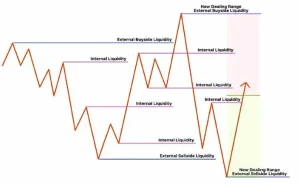
- Liquidity: Liquidity is arguably the most central concept in ICT Trading. It refers to price areas where a large number of orders are likely sitting — previous highs and lows, equal highs and lows, trendline stops, and the highs and lows of specific trading sessions. Institutions tend to target these pools of liquidity before making a decisive move, which is why identifying them accurately matters so much.
- Liquidity Sweep: A liquidity sweep happens when price briefly pushes past an obvious support or resistance level, triggers the stop-loss orders resting there, and then reverses. New traders often mistake this for a genuine breakout, while those trained in ICT Trading tend to interpret it as liquidity being collected before a reversal. This dynamic explains why so many apparent breakouts fail.
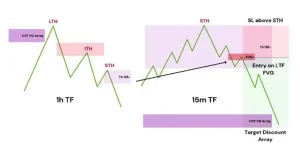
- Fair Value Gap (FVG): A Fair Value Gap forms when price moves aggressively in one direction, leaving an imbalance between buyers and sellers rather than trading through every level evenly. In ICT Trading, these gaps are often expected to be revisited before the broader trend resumes, which makes them popular high-probability entry zones.
- Order Blocks: Order blocks mark the areas where institutions are believed to have placed large buy or sell orders just before a significant price move. Instead of entering on impulse, traders practicing ICT Trading wait for price to return to these zones and look for confirmation first. An order block gains extra weight when it lines up with both liquidity and market structure.
- Break of Structure (BOS): A break of structure occurs when price pushes through a meaningful prior swing high or swing low. This event typically signals that momentum has shifted, and traders use it to judge whether buyers or sellers currently hold control of the market.
- Change of Character (CHOCH): A change of character is often the earliest hint that market direction may be turning. Unlike a full trend reversal, CHOCH focuses on catching subtle institutional shifts before a new trend fully develops, and many traders treat it as an early warning to tighten risk or prepare for a new setup.
Read More: What is Swing Trading Strategy?
Why Has ICT Trading Become So Popular?
A handful of factors explain the rapid rise of ICT Trading among retail and semi-professional traders alike:
- Indicator-free analysis: ICT Trading leans on price action rather than lagging indicators, giving traders cleaner charts and a deeper feel for how the market actually behaves.
- An institutional lens: instead of asking where retail traders are positioned, ICT Trading pushes traders to ask where institutions are likely entering — a shift in perspective that appeals to those seeking a more professional edge.
- Disciplined risk management: the methodology rewards patience and carefully planned entries over frequent trading, and many of its setups naturally offer favorable risk-to-reward ratios.
Advantages of ICT Trading
Advantages of ICT Trading are:
- Centers analysis on institutional market behavior
- Applicable across multiple financial markets
- Works on a variety of timeframes
- Encourages disciplined, well-planned trade execution
- Often produces attractive risk-to-reward setups
- Reduces reliance on technical indicators
Disadvantages of ICT Trading
For all its appeal, ICT Trading is far from easy to master. Common challenges include a steep learning curve, a large number of advanced concepts to absorb, the need for extensive chart study, inconsistent interpretation between traders looking at the same chart, and difficulty for beginners in correctly spotting liquidity. As with any methodology, real progress comes only through consistent, deliberate practice.
Is ICT Trading Suitable for Beginners?
Yes — but it’s best approached step by step rather than all at once. Trying to absorb every ICT Trading concept simultaneously tends to overwhelm new traders. A more sensible learning path moves through market structure, liquidity, liquidity sweeps, fair value gaps, order blocks, break of structure, and change of character, in that order. Mastering each piece individually makes the full framework far easier to internalize.
Read More: Forex vs Crypto Trading
ICT Trading vs. Technical Analysis (Comparison Table)
| ICT Trading | Technical Analysis |
| Focuses on liquidity | Focuses on indicators |
| Institutional perspective | Retail perspective |
| Uses market structure extensively | Often emphasizes chart patterns |
| Price action driven | Indicator driven |
| Emphasizes order flow concepts | Emphasizes historical signals |
Common Mistakes in trading with ICT
Beginners tend to fall into similar traps: trading every liquidity sweep they spot, ignoring the broader trend, entering before waiting for confirmation, risking too much on a single trade, and trying to learn every concept of ICT Trading at once. Patience and consistency matter far more than the number of trades taken.
Read More: Forex Backtesting Guide
Conclusion about trading with ICT
ICT Trading has become one of the most influential price-action methodologies in modern financial markets. By centering analysis on liquidity, market structure, order blocks, Fair Value Gaps, and institutional behavior, it helps traders understand why price moves the way it does, rather than simply reacting after the fact. The learning curve is steeper than many traditional approaches, but traders who put in the time to master its core concepts often come away with sharper analytical instincts and a more structured trading process. Whether you’re new to Forex or already familiar with Smart Money Concepts, spending time with ICT Trading can offer real insight into how institutions move the market — and help you make better-informed trading decisions as a result.
Source: Investopedia