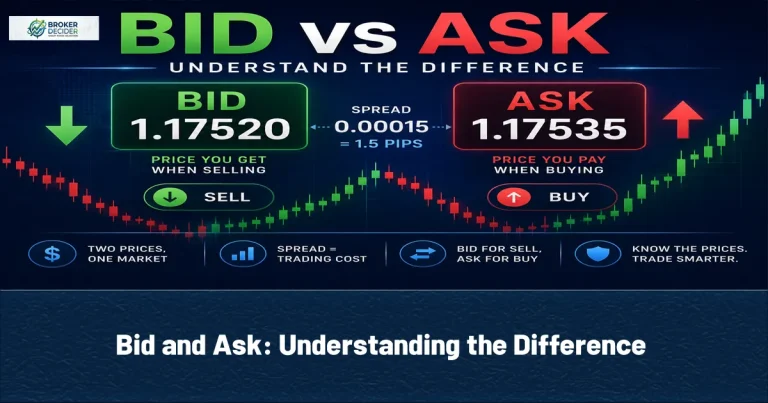
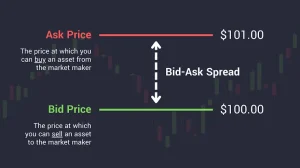
Every Forex quote shows two numbers that are Bid and Ask. The Bid is the highest price buyers are currently willing to pay; the Ask is the lowest price sellers are currently willing to accept. The gap between them is the spread, calculated as Ask minus Bid. For example, if EUR/USD shows a Bid of 1.17520 and an Ask of 1.17535, the spread is 0.00015 or 1.5 pips, since one pip on most major pairs equals 0.00010. A market Buy order fills at the Ask; a market Sell order fills at the Bid.
Bid Price
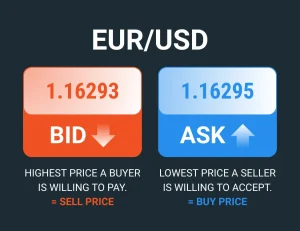
The Bid price is what you receive when you sell. If you open a Sell (Short) position at market price, the trade executes immediately at the current Bid.
For example (EUR/USD):
- Bid: 1.17520 Ask: 1.17535
- Selling immediately fills the order at 1.17520.
Ask Price
The Ask price is what you pay when you buy. If you open a Buy order using market execution, the trade opens at the Ask price.
For example (EUR/USD):
- Bid = 1.17520 Ask = 1.17535
- A Buy order opens at 1.17535.
Bid-Ask Spread
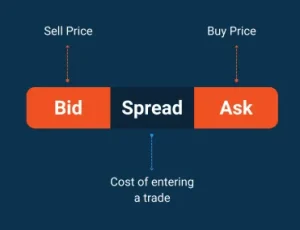
The spread is the numerical difference between the Ask and Bid: Spread = Ask Price − Bid Price.
Example calculation:
- Ask = 1.17535 Bid = 1.17520 Spread = 1.17535 − 1.17520 = 0.00015 = 1.5 pips
Why Does the Spread Exist?
The spread compensates liquidity providers and market makers for facilitating trades, and it shifts with market conditions. The main factors that move it are liquidity, trading volume, market volatility, the current trading session, economic news releases, and a broker’s execution model. As a general rule, higher liquidity produces a narrower spread.
Typical Bid-Ask Spreads in Forex
Spreads vary by broker and by market conditions, but the table below shows approximate ranges for major currency pairs during normal trading hours.
| Currency Pair | Spread (Pips) |
| USD/JPY | 0.2 – 1.0 |
| USD/CAD | 0.6 – 1.5 |
| AUD/USD | 0.5 – 1.2 |
| EUR/USD | 0.1 – 1.0 |
| USD/CHF | 0.6 – 1.4 |
| NZD/USD | 0.8 – 1.8 |
| GBP/USD | 0.6 – 1.5 |
Bid and Ask Example
Suppose EUR/USD is quoted at a Bid of 1.17520 and an Ask of 1.17540 — a spread of 2 pips. You buy one Standard Lot. Since one pip is worth approximately $10 on a Standard Lot, the initial trading cost works out to 2 × $10 = $20. That means the position opens with an unrealized loss of roughly $20, purely from the spread, before price has moved at all.
Bid and Ask in Different Lot Sizes
The dollar impact of a spread scales directly with position size. Here’s the same 2-pip spread applied across different lot sizes:
| Lot Size | Pip Value | Cost of a 2-Pip Spread |
| Standard Lot (100,000 units) | ≈ $10 | ≈ $20 |
| Mini Lot (10,000 units) | ≈ $1 | ≈ $2 |
| Micro Lot (1,000 units) | ≈ $0.10 | ≈ $0.20 |
| Nano Lot (100 units) | ≈ $0.01 | ≈ $0.02 |
Why Do Spreads Widen?
In your opinion, Why Do Spreads Widen? The answer is here:
- High-impact news
- Market open and close
- Low-liquidity sessions
- Extreme volatility
Fixed vs. Variable Spreads
Some brokers offer fixed spreads, while others quote floating (variable) spreads that move with the market.
| Fixed Spread | Variable Spread |
| Easier to plan costs around | Often lower during highly liquid periods |
| Stays relatively constant | Changes with market conditions |
| Can still widen under exceptional conditions | Can spike sharply during volatility |
Bid and Ask and Market Orders
Market orders execute immediately: Buy orders fill at the Ask, and Sell orders fill at the Bid. This is exactly why a freshly opened position usually starts out with a small unrealized loss equal to the spread.
Bid and Ask and Limit Orders
Pending orders interact with these two prices a bit differently. A Buy Limit order activates when the Ask reaches the specified level, while a Sell Limit order activates when the Bid reaches the specified level. Knowing this distinction helps traders avoid confusion when a pending order doesn’t seem to trigger at the exact price shown on the chart.
Advantages of Understanding Bid and Ask
The advantages of understanding Bid and Ask are:
- Makes broker pricing genuinely comparable
- Improves order placement
- Reduces confusion about chart prices
- Allows accurate calculation of trading costs
- Supports more effective short-term trading strategies
- Clarifies exactly which price a trade executes at
Conclusion about Bid and Ask
Every market order executes at either the Bid or the Ask, and the gap between the two (spread) is a real, calculable cost applied before a trade has even had the chance to move in your favor. On a 2-pip EUR/USD spread, a single Standard Lot costs about $20 up front; the same spread on a Micro Lot costs about $0.20.
Rather than treating the spread as a footnote, successful traders factor Bid and Ask prices directly into trade planning, broker evaluation, and risk management.
Source: Investopedia