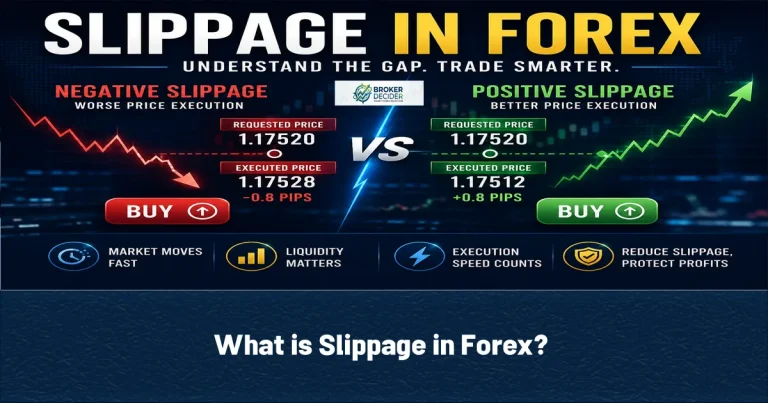
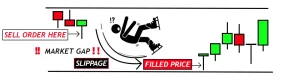
Slippage in Forex is the difference between the price you requested and the price your order actually filled at. It can go either way: place a market Buy order for EUR/USD at 1.17520 and get filled at 1.17528, and you’ve experienced 0.8 pips of negative slippage; get filled at 1.17516 instead, and that’s 0.4 pips of positive slippage. On one Standard Lot, where a pip is worth about $10, that 0.8-pip difference translates to roughly $8. Slippage is not, by itself, a sign of broker error. It’s a routine consequence of market volatility, shifting liquidity, and how fast prices update between order submission and execution.
The reason Slippage Happen
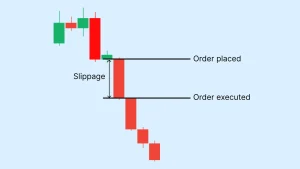
Financial markets run as continuous electronic auctions, and prices can change several times within a single second during active periods. Your order follows a short chain: you submit it, the platform sends it to the broker, the broker routes it to a liquidity provider or market maker, the order gets matched against available liquidity, and the trade executes. If the requested price is no longer available by the time the order reaches the market, it fills at the next available price instead.
Positive and Negative Slippage in Forex
Slippage can work in your favor or against you, and both are a normal part of trading.
- Positive Slippage: Positive slippage happens when your order fills at a better price than requested. Example: you request a Buy at EUR/USD 1.17520, and it executes at 1.17516 (a 0.4-pip improvement). On one Standard Lot, where a pip is worth about $10, that’s roughly $4 in your favor.
- Negative Slippage: Negative slippage happens when execution lands at a worse price. Example: you request a Sell at GBP/USD 1.36050, and it executes at 1.36042 (0.8 pips worse). On a Standard Lot, that adds about $8 in extra cost before spreads or commissions are even factored in.
Cost of Slippage
The financial impact scales directly with both the amount of slippage and the position size. Here’s the cost of just 1 pip of slippage across different lot sizes:
| Position Size | Cost of 1 Pip of Slippage |
| Standard Lot | 10 USD |
| Mini Lot | 1 USD |
| Micro Lot | 0.1 USD |
| Nano Lot | 0.01 USD |
Causes of Slippage
Causes of Slippage are:
- High Market Volatility: Major economic releases (U.S. Non-Farm Payrolls (NFP), the Consumer Price Index (CPI), Federal Reserve rate decisions, European Central Bank announcements, and Bank of England policy decisions) can move prices by dozens of pips within seconds, sharply raising the odds of slippage.
- Low Liquidity: Slippage becomes more common whenever fewer participants are actively trading (during the late New York session, market rollover, public holidays, or weekend opens). Lower liquidity simply means fewer orders sitting at each price level.
- Large Order Sizes: Institutional-sized orders often exceed the liquidity available at a single price. Instead of filling instantly at one level, the order gets filled across multiple price levels.
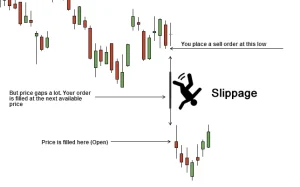
- Fast Market Conditions: Unexpected geopolitical events, central bank interventions, or major corporate news can cause prices to gap between available quotes, meaning the requested price may simply vanish before the order reaches execution.
News Trading and Slippage
News releases are where slippage tends to show up most dramatically. Suppose EUR/USD is trading at 1.17500 and an unexpected inflation report sends price jumping straight to 1.17610. A Buy Market order submitted right at that moment could execute anywhere between those two prices depending on available liquidity ( a 110-pip range). That’s exactly why many experienced traders avoid placing market orders in the exact instant a major release hits.
Slippage and Spread
Slippage and spread get confused often, but they’re genuinely different things.
| Slippage | spread |
| Difference between requested and executed price | Difference between Bid and Ask prices |
| Influenced by execution speed and liquidity | Influenced by market conditions and broker pricing |
| Changes unexpectedly | Usually visible before entering a trade |
| May be positive or negative | Represents a standard, predictable trading cost |
Slippage and Requotes
Some brokers issue a requote instead of simply executing at a different price.
| Slippage | requote |
| No manual confirmation required | Trader must approve the new quote |
| Order executes automatically at the available price | Broker asks the trader to accept a new price |
| Common with Market Execution | More common with Instant Execution |
The Methods of Reducing Slippage
For reducing slippage in forex, use the methods below:
- Trade during liquid sessions
- Avoid major news releases
- Use Limit Orders
- Choose a broker with fast execution
- Monitor VPS latency
Which Trading Styles Are Most Affected by slippage in forex?
The possibility of slippage occurrence in Scalping and News Trading strategies is too high but for Swing Trading and Position Trading, this possibility is too low.
Conclusion about Slippage in Forex
Slippage in Forex is a normal byproduct of how electronic markets match orders under constantly shifting conditions, not inherently a sign of broker error. Its size depends on volatility, liquidity, order size, and execution speed. It can’t be eliminated entirely, but it can be reduced through better timing, appropriate order types, faster execution infrastructure, and disciplined risk management.
Source: Investopedia