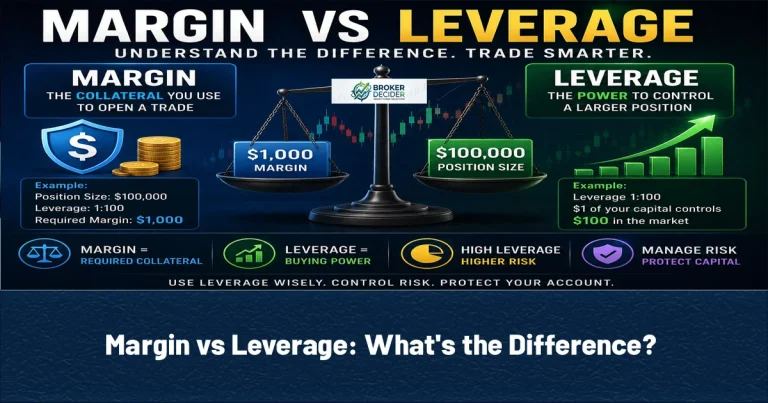
Margin vs Leverage – What’s the Difference? Leverage is the ratio that sets how much market exposure you can control with your own capital; Margin is the exact amount of money your broker sets aside from your account as collateral to keep that leveraged position open. With 1:100 leverage, controlling a $100,000 Forex position requires exactly $1,000 in margin — calculated as Position Size ÷ Leverage. Push that same $100,000 position to 1:50 leverage and required margin doubles to $2,000; push it to 1:500 and margin drops to just $200. The position size never changes across any of these — only the amount of collateral required to hold it does.
What Is Leverage?
Leverage lets traders control a larger market position using a relatively small amount of their own money. It’s expressed as a ratio — common examples are 1:10, 1:30, 1:50, 1:100, 1:200, and 1:500. With 1:100 leverage, every $1 of capital controls $100 in the market. Example: an account balance of $2,000 at 1:100 leverage gives a maximum theoretical buying power of $2,000 × 100 = $200,000. Leverage itself doesn’t directly increase profits or losses — it simply enables larger positions, and larger positions naturally magnify both gains and losses.
What Is Margin?
Margin is the portion of your account balance that the broker temporarily reserves as collateral for an open trade. It is not a fee — it stays part of your account equity, but it can’t be used to open additional positions while the original trade remains active. Example: a position of 100,000 EUR at 1:100 leverage requires margin of 100,000 ÷ 100 = 1,000 EUR. If the account is denominated in USD, the exact dollar figure depends on the EUR/USD exchange rate at the moment the trade is opened.
Margin and Leverage Work Together
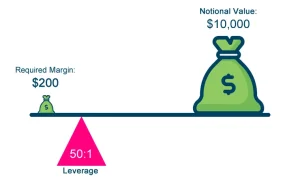
The relationship is a simple formula: Required Margin = Position Size ÷ Leverage. Here’s how that plays out on a fixed $100,000 position:
| Leverage | Margin |
| 1:50 | 2000 USD |
| 1:100 | 1000 USD |
| 1:200 | 500 USD |
| 1:500 | 200 USD |
Higher leverage reduces the margin required to open the same position — but it does not reduce the market risk of that position.
Margin Requirement by Leverage
The table below converts common leverage ratios into their equivalent margin percentage, using Margin (%) = 100 ÷ Leverage.
| Leverage | Margin Requirement |
| 1:10 | 10 % |
| 1:20 | 5 % |
| 1:30 | 3.33 % |
| 1:50 | 2 % |
| 1:100 | 1 % |
| 1:200 | 0.5 % |
| 1:500 | 0.2 % |
Example: Buying 1 Standard Lot of EUR/USD
A Standard Lot of EUR/USD represents a $100,000 position. Here’s what changes across three leverage scenarios:
- Scenario 1 — Leverage 1:50 → Required Margin: $2,000
- Scenario 2 — Leverage 1:100 → Required Margin: $1,000
- Scenario 3 — Leverage 1:500 → Required Margin: $200
Higher Leverage Increase Risk. True?
Higher leverage does not automatically increase risk. Risk actually depends on position size, stop-loss distance, Lot Size, account balance, and the risk percentage taken per trade.
Compare two traders directly: Trader A uses 1:500 leverage on a 0.10 Lot position, risking 1% of the account. Trader B uses only 1:30 leverage but opens a 5-Lot position, risking 20% of the account. Despite using far lower leverage, Trader B is taking substantially more risk, purely because of the much larger position size.
Margin vs Leverage; Differences
Margin vs Leverage:
| Margin | Leverage |
| Reserved while a position stays open | Determines maximum market exposure |
| Depends on leverage and position size | Chosen according to broker limits |
| Expressed as money or a percentage | Expressed as a ratio |
| Collateral required to open a trade | Ratio that increases buying power |
| Does not change pip value | Does not change pip value |
Margin Call and Leverage
Margin is closely tied to the idea of a Margin Call, which occurs when account equity falls below the broker’s required maintenance level.
For example, an account with a $5,000 balance and $4,500 in used margin experiences an open loss of $1,200, leaving remaining equity of $3,800. If that breaches the broker’s maintenance requirement, the trader may receive a Margin Call, or positions may be closed automatically depending on the broker’s stop-out policy. Leverage itself does not trigger Margin Calls — oversized positions and insufficient available equity do.
Margin vs Leverage; Misconceptions
When we are Talking about Margin vs Leverage, We must avoid these Misconceptions:
- Higher leverage is always dangerous
- Margin is a trading fee
- Lower leverage guarantees lower risk
- Leverage changes pip value
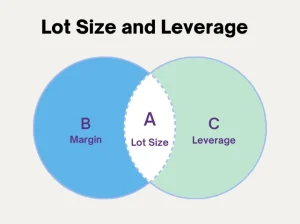
Conclusion about Margin vs Leverage
Leverage determines how much market exposure a trader can control; Margin is the exact collateral required to maintain that exposure, calculated directly as Position Size ÷ Leverage. On a fixed $100,000 position, that’s $2,000 at 1:50, $1,000 at 1:100, or $200 at 1:500 — the leverage ratio changes the collateral required, not the underlying market risk.
Source: Investopedia