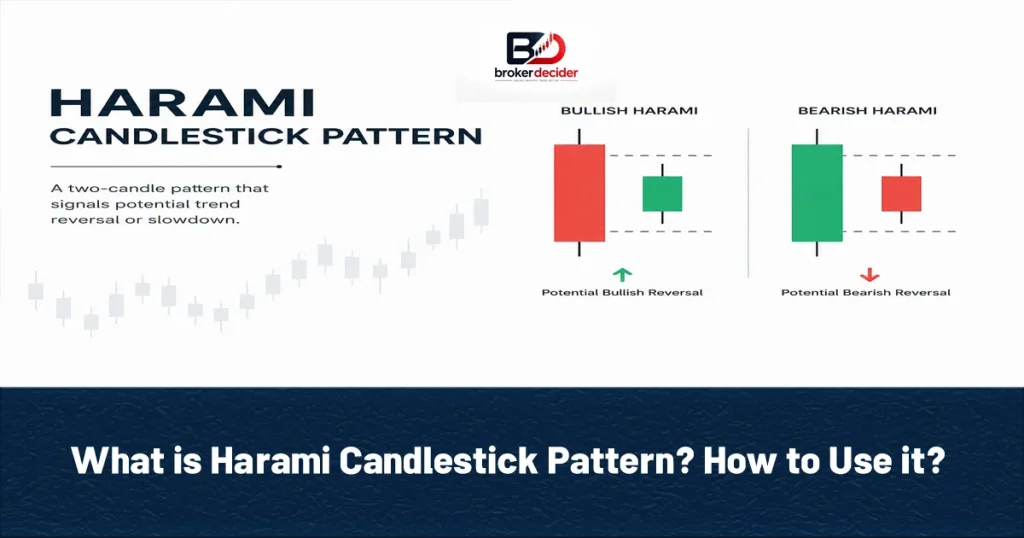
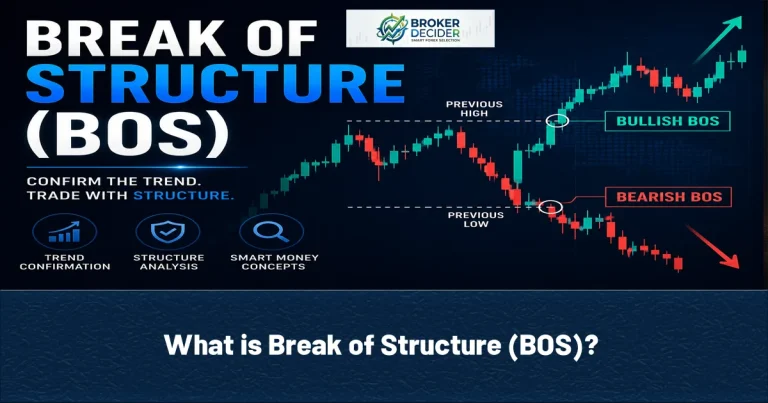
Break of Structure or BOS is a price action concept that traders use to confirm whether an existing market trend is still intact. Within ICT Trading and Smart Money Concepts (SMC), Break of Structure marks the moment price decisively pushes through a meaningful swing high or swing low in the same direction the market was already moving.
What is BOS?
Break of Structure describes the moment a market confirms that its current trend is continuing. Rather than simply watching price cross a horizontal level, as a traditional breakout strategy might, Break of Structure looks at the sequence of swing highs and swing lows to judge whether buyers or sellers remain in control. Because it reflects continuation rather than reversal, Break of Structure has become one of the most frequently referenced concepts across institutional trading methodologies.
Why Break of Structure is important?
Markets rarely travel in a straight line. Instead, price builds a rhythm of highs and lows that reveal the ongoing tug-of-war between buyers and sellers. A confirmed Break of Structure gives traders objective evidence that the dominant side of that tug-of-war still has the upper hand.
Mechanism of BOS
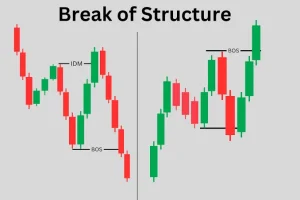
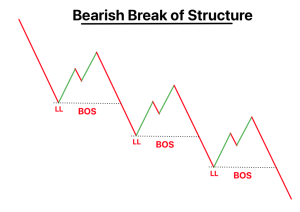
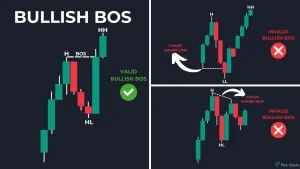
Every trend tends to follow a recognizable rhythm. In an uptrend, price typically prints a series of Higher Highs (HH) and Higher Lows (HL). A bullish Break of Structure occurs when price pushes above the previous Higher High, confirming that buyers are still driving the market. In a downtrend, price instead forms Lower Highs (LH) and Lower Lows (LL). A bearish Break of Structure occurs when price falls below the previous Lower Low, confirming that sellers remain in charge. In both cases, the underlying idea is the same: the market is extending its existing structure rather than reversing it.
Bullish BOS
A bullish Break of Structure unfolds during an uptrend, and it typically follows a familiar sequence: price forms a Higher Low, buying pressure pushes the market upward, and price then breaks above the prior Higher High, confirming the bullish trend.
Bearish BOS
A bearish BOS follows the mirror-image sequence: price forms a Lower High, selling pressure builds, and price then breaks below the prior Lower Low, confirming the downtrend.
Break of Structure vs. Change of Character
Beginners often mix up BOS with CHOCH, since both involve a break in market structure. In practice, though, they describe very different conditions:
| Break of Structure or BOS | Change of Character or CHOCH |
| Occurs in the direction of the current trend | Often appears before a new trend develops |
| Higher confidence in continuation | An early warning rather than confirmation |
| Confirms trend continuation | Suggests a possible trend reversal |
| Reinforces existing market structure | Signals that market control may be shifting |
BOS vs. Market Structure
Market Structure is the broader framework describing how price builds highs and lows over time. Break of Structure is simply one event that happens within that framework. Put another way, Market Structure explains the trend itself, while BOS confirms that the trend is still intact. Without a solid grasp of Market Structure first, spotting a genuine Break of Structure becomes far more difficult.
Identifying Break of Structure in 4 steps
BOS can be identified within these 4 steps:
| step 1 | Identify the Current Trend | Start by determining whether price is forming Higher Highs and Higher Lows, or Lower Highs and Lower Lows. |
| step 2 | Locate the Key Swing Level | Identify the most recent significant swing high or swing low. |
| step 3 | Wait for a Confirmed Break | A genuine Break of Structure requires price to push through the key swing level with real conviction. |
| step 4 | Watch the Pullback | wait for price to retrace into an Order Block, a Fair Value Gap, or a liquidity zone. |
Break of Structure within ICT Trading
Inside ICT Trading, Break of Structure is rarely analyzed in isolation. Traders typically combine it with a handful of other institutional concepts, including liquidity, liquidity sweeps, Order Blocks, Fair Value Gaps, premium and discount zones, Market Structure, and Change of Character. When several of these concepts line up together, traders generally treat the overall setup as more reliable.
Common Mistakes of Trading with BOS
Common Mistakes of Trading with BOS are:
- Treating every break as BOS
- Ignoring higher timeframes
- Chasing momentum
- Ignoring liquidity
Advantages of Trading with BOS
Advantages of Trading with BOS are:
- Confirms trend continuation
- Removes emotional, guesswork-driven decisions
- Works well alongside broader price action analysis
- Supports core ICT Trading concepts
- Applicable across multiple financial markets
- Improves overall trade planning
Conclusion about BOS
Break of Structure (BOS) is one of the building blocks of both ICT Trading and Smart Money Concepts. Rather than relying on indicators or subjective opinion, Break of Structure gives traders a price-action-based way to judge whether buyers or sellers still control the market by confirming that the existing trend remains intact.
Recommended Brokers for Forex Trading
These brokers can be suitable for forex trading. However, you should always take the risks of trading into consideration.
Sign Up with Errante Sign Up with Orbex Sign Up with HYCM
Source: Investopedia