Over the past few years, the conversation around Forex Broker vs Prop Firm has become much bigger in the trading industry. More traders are now exploring funded trading programs, while traditional forex brokers continue to dominate the retail trading market. At first glance, both options may look similar because they both give traders access to the forex market. However, the structure behind them is completely different. One model is built around personal capital, while the other focuses on funded accounts and performance-based evaluations. For traders who are just entering the market, understanding the difference between a forex broker and a prop firm can help avoid unrealistic expectations and unnecessary risks.
Read More: How to Choose a Forex Broker?
Forex Broker vs Prop Firm: Two Different Trading Models
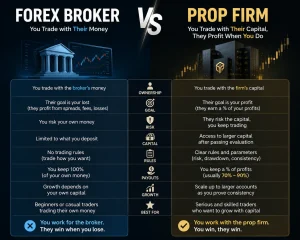
The core difference in the Forex Broker vs Prop Firm comparison comes down to who provides the trading capital. A forex broker gives traders access to the market after they deposit their own funds. The trader controls the account, accepts all risks, and keeps all profits. A prop firm works differently. Instead of depositing large amounts of personal money, traders usually go through a challenge or evaluation process. If they meet the required targets, the firm provides access to a funded account and shares a percentage of the profits. Although both paths involve forex trading, the trader’s responsibilities and limitations can be very different.
Trading With a Forex Broker
Traditional forex brokers remain the most common way to access the forex market. After opening an account, traders can Deposit funds, Choose leverage levels, Access trading platforms and Manage positions independently. Most brokers support popular platforms such as MetaTrader 4, MetaTrader 5 and cTrader.
One reason many traders prefer brokers is flexibility. In most cases, traders can build their own strategies without strict limitations. Scalping, swing trading, automated systems, and long-term positions are generally allowed depending on the broker’s conditions. However, the biggest downside is simple: traders risk their own capital.
Read More: Complete Guide to Choose a Forex Broker
Trading With a Prop Firm
The rapid growth of funded trading programs has made prop firms increasingly popular among retail traders. In a typical setup: The trader pays an evaluation fee. The trader must follow risk rules and reach profit targets. If successful, the trader receives a funded account.
Instead of using large personal deposits, traders gain access to company capital. Profits are then divided between the trader and the firm based on an agreed percentage. This structure attracts traders who want access to higher capital without risking substantial personal savings.
Forex Broker vs Prop Firm: Freedom vs Rules
One of the biggest differences in the Forex Broker vs Prop Firm discussion is trading freedom. Forex brokers usually provide more flexibility. Traders can often:
- Hold trades longer
- Trade during news events
- Use aggressive strategies
- Customize risk exposure
Prop firms typically operate with stricter controls. Common rules may include:
- Maximum daily drawdown
- Overall account loss limits
- Restrictions during high-impact news
- Position size limitations
These rules are designed to protect the firm’s capital, but some traders may find them restrictive.

Read More: Forex Broker Regulation: Types and Importance (3 types of regulation)
Capital Requirements and Financial Risk
Financial exposure is another important factor when comparing brokers and prop firms. With a forex broker, Traders deposit personal funds, All losses come directly from the trader’s account and Account growth depends on available capital. With a prop firm, Traders usually pay only the challenge fee initially, The firm provides larger account sizes after approval and Personal financial exposure may be lower. For some traders, this lower upfront risk is one of the biggest advantages of prop firms.
Profit Structure and Earnings
The way profits are handled is very different between the two models. When using a broker, Traders keep all profits and Traders also absorb all losses. With prop firms, Profits are shared with the company, Profit splits often range between 70% and 90% and The trader gains access to larger capital in return. Some traders prefer complete ownership of profits, while others prioritize access to bigger funded accounts.
Which Option Is Better for Beginners?
The answer depends on the trader’s personality, goals, and risk tolerance. Beginners who want full control and fewer restrictions may feel more comfortable with a forex broker. Demo accounts also make it easier to practice before risking real money. On the other hand, some beginners are attracted to prop firms because they reduce the need for large personal deposits. Still, passing evaluation challenges can be difficult without strong discipline and consistent risk management. In reality, many new traders underestimate the psychological pressure involved in funded account programs.

Forex Broker vs Prop Firm: Long-Term Perspective
The long-term experience can also differ significantly. Forex brokers allow traders to gradually scale personal accounts over time. Traders have full ownership of account growth and strategy development. Prop firms focus more on performance consistency. Traders who repeatedly violate rules may lose funded account access, even after generating profits. For this reason, traders should evaluate not only profit potential, but also sustainability and trading style compatibility.
Read More: HYCM Broker Review
Final Thoughts about Forex Broker vs Prop Firm
The growing popularity of funded trading has made the Forex Broker vs Prop Firm comparison more relevant than ever. Both models offer advantages, but they are designed for different types of traders. Forex brokers provide flexibility, independence, and full profit ownership. Prop firms offer access to larger trading capital with structured risk management rules. There is no universal answer for every trader. The better choice depends on trading experience, emotional discipline, financial goals, and personal risk tolerance.
source: Investopedia