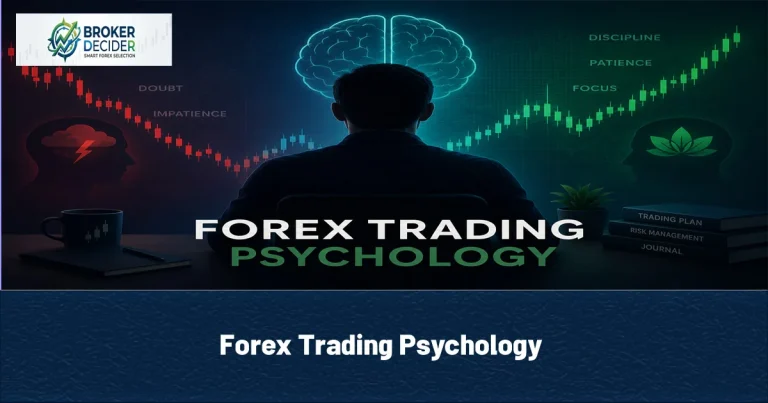
Forex trading psychology is the part of trading that nobody talks about enough — and the part that ends more careers than bad strategies ever will. Most traders who blow their accounts aren’t undone by technical analysis failures. They’re undone by themselves: by the revenge trade after a rough morning, by holding a winner too long because they got greedy, by skipping a valid setup because the last three trades lost. The market didn’t beat them. Their own mind did. This guide is about fixing that — not with vague advice about staying calm, but with a concrete understanding of what’s actually happening in your head when you trade, and what to do about it.
Read More: EUR/USD Forecast 2026
Why Forex Trading Psychology Is the Real Edge?
Here is the uncomfortable truth about forex trading psychology: most traders already know what they should do. They know they shouldn’t revenge trade. They know they should respect their stop loss. They know FOMO entries are a bad idea. The knowledge is not the problem. The execution is.
The gap between knowing and doing exists because trading is uniquely designed to work against your instincts. Every psychological reflex that helped humans survive — avoid pain, seek reward, follow the herd — becomes a liability when applied to markets. Cutting a loss feels like admitting failure. Holding a winner feels safer than locking in profit. Jumping into a trade that’s already moved feels better than sitting on your hands and waiting.
A 2024 study of retail forex accounts found that traders who maintained a consistent pre-trade routine — including an emotional check-in before session start — showed 34% higher plan adherence compared to a control group running the same strategy without the routine. The strategy was identical. The psychology was not. That 34% difference is the gap between a losing and a profitable account.
The Six Emotional Traps That Destroy Forex Accounts
Every psychological mistake in trading traces back to one of six emotional states. Understanding what each one looks like — not in theory but in the actual moment it happens — is the first step to catching it before it costs you money:
- Fear
- Greed
- Revenge Trading
- Overconfidence
- Analysis Paralysis
- Loss Aversion
Read More: Best Forex Indicators in 2026
Fear: The Emotion That Makes You Your Own Worst Enemy
Fear in trading has two faces. The first is fear of loss — which makes you exit winning trades early (you’re up 60 pips but panic at a minor pullback and close for 25), refuse valid setups because the last trade lost, or reduce position size so far below optimal that even a run of winners doesn’t cover the losers. The second is fear of missing out (FOMO) — which makes you do the exact opposite: chase entries after the move has already happened, accept poor risk: reward because you can’t stand watching the market go without you.
Both are driven by the same root cause: you are making decisions based on what you feel rather than what the chart is telling you. The market does not know you exist. Your feelings have no effect on where price goes next.
Greed: The Emotion That Turns Winners into Losers
Greed is subtler than fear and harder to catch in real time. It shows up when you remove a take-profit target because the trade is going well and you think it will keep going. It shows up when you add to a position that has already hit your original target. It shows up when you keep trading after hitting your daily profit target because you feel ‘in the zone’. In every case, greed is optimism untethered from plan — and the market has a long history of punishing it.
Read More: Forex Copy Trading in 2026
Revenge Trading: The Most Expensive Habit in Forex
Revenge trading is what happens after a painful loss when the brain shifts from analytical mode into emotional recovery mode. The goal stops being execute the strategy and becomes get the money back. Positions get bigger. Setup criteria get looser. Risk management gets suspended. The result, almost invariably, is a second loss larger than the first — and sometimes an account-ending drawdown that started with one bad trade and a refusal to accept it.
The fix is mechanical, not motivational: after any loss exceeding 1% of account equity, close the charts and walk away for at least 30 minutes. Not because the market will be better in 30 minutes, but because you will be.
Overconfidence: What a Winning Streak Does to Your Brain
A winning streak is one of the most dangerous things that can happen to a retail trader. After five or six consecutive wins, the brain starts rewriting the narrative: you’ve cracked it, you’ve found your edge, the system is working. Position sizes increase. Stop losses get skipped ‘just this once’. Setup criteria get stretched to include trades that wouldn’t have passed the checklist a week ago. Then one loss — often a large one because the position size grew — wipes the gains from multiple winners and leaves you questioning everything. Your next trade genuinely has no memory of the last ten. Size it the same way regardless.
Read More: Forex Risk Management; The Complete Framework for Protecting Your Trading Capital
Analysis Paralysis: Overthinking as a Form of Avoidance
Some traders have the opposite problem to impulsiveness: they over-analyze, wait for confirmation from every possible indicator, and ultimately watch valid setups go without them because they could never feel sure enough to act. Analysis paralysis is usually a fear response dressed up as diligence. The solution is a written pre-entry checklist with a fixed number of criteria — if all boxes are ticked, the trade meets the criteria and execution is required. Remove the discretion, remove the paralysis.
Loss Aversion: Why Losses Hurt More Than Wins Feel Good
Behavioral economics research — particularly the work of Kahneman and Tversky on prospect theory — consistently shows that the psychological pain of a loss is approximately twice as powerful as the pleasure of an equivalent gain. In trading, this means that a $100 loss feels worse than a $100 win feels good. The practical consequence: traders tend to hold losing trades too long (hoping to avoid crystallizing the loss) and cut winning trades too early (locking in the good feeling before the market can take it back). Both behaviors systematically damage expectancy over time.
Read More: Best Forex Trading Strategies: A Practical Guide for Consistent Traders in 2026
Building a Forex Trading Psychology That Actually Holds Up
Knowing what the emotional traps are is not enough. The traders who manage psychology successfully do so through systems and habits — not through willpower alone. Willpower is a finite resource. Systems are not.
The Trading Journal: Your Most Underused Tool
A trading journal is the single most effective tool for improving forex trading psychology — and the one most traders skip because it feels tedious. A journal that captures not just the trade details (entry, exit, result) but your emotional state before and after each trade will, over three to six months, show you exactly which emotions are costing you the most money. You cannot improve what you cannot see. The journal makes the invisible visible.
The Pre-Session Routine
Surgeons scrub in. Athletes warm up. Professional traders have a pre-session routine that puts them in the right mental state before a single position is opened. It does not need to be complex. A 10-minute routine that includes reviewing your key levels, setting your daily loss limit, checking the economic calendar for high-impact events, and doing a brief emotional check-in (‘How am I feeling right now? Am I carrying frustration from yesterday?’) covers the essential bases. The 34% plan adherence improvement noted earlier came from traders who added exactly this kind of structured pre-session process.
Rules That Remove Decisions
The best psychological tool in trading is a rule that makes a decision for you before the emotional state arises. Pre-set take-profit orders. Hard daily loss limits. No-trade zones around high-impact news. A requirement to close the platform after reaching the daily profit target. These rules remove the moment of temptation entirely — which is far more effective than relying on in-the-moment willpower to resist it.

Read More: Price Action Forex Trading
Final Thoughts: Forex Trading Psychology
Forex trading psychology is not a soft skill. It is the difference between a trader who survives long enough to develop a real edge and one who cycles through strategies, blames the market, and eventually quits. The technical side of trading — chart reading, indicators, risk management — is learnable in months. The psychological side takes years, and only develops through deliberate practice, honest self-assessment, and a willingness to treat your own behavior as the primary variable to optimize.
The traders who last are not the ones who feel no emotion. They are the ones who built systems that reduce the cost of feeling it. Start with a journal. Add a pre-session routine. Write rules that make decisions before the emotions arrive. That is the work. It is unglamorous, it is slow, and it is the only thing that actually changes the outcome.
Source: Investopedia