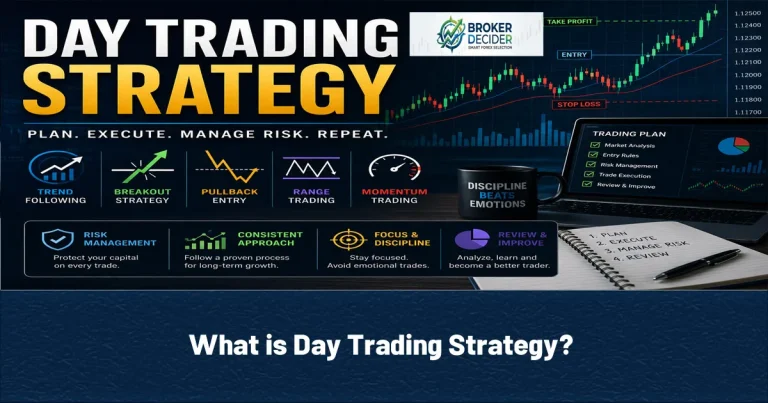
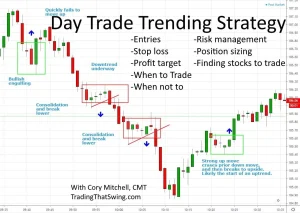
A day trading strategy is a defined set of rules for entering and exiting trades within a single session. A strategy that holds up defines the markets you trade, the timeframes you read, the exact entry trigger, where the stop and target sit, maximum daily risk, position sizing, and the conditions under which you don’t trade at all. Profitable day trading isn’t about calling every move correctly. It’s running a repeatable process with positive expectancy across a large enough sample of trades that an occasional losing streak doesn’t matter.
The Difference Between Day Trading and Other Styles
The one non-negotiable rule: nothing stays open once the session ends. A five-minute scalp and a five-hour swing within the day both count as day trades; a position held into the next session doesn’t.
| Style | Typical Hold Time | Trade Frequency | Overnight Risk |
| Scalping | Seconds to minutes | Very high | None |
| Day Trading | Minutes to hours | Moderate | None |
| Swing Trading | Days to weeks | Low | Yes |
| Position Trading | Weeks to months | Very low | Yes |
Why Day Trading?
No overnight exposure, faster feedback for learning, and the ability to work multiple liquid markets in one session are the real draws. The tradeoff: decisions happen fast, under pressure. Without a structured plan, that pace turns into overtrading fast — more tickets, not better ones.
Day Trading Markets
Forex stays open 24 hours across five days, with EUR/USD, GBP/USD, USD/JPY, and USD/CAD offering the deepest liquidity and tightest spreads during active sessions. Index CFDs and futures — S&P 500, NASDAQ 100, DAX 40, FTSE 100 — respond sharply to macro data and institutional flow. Gold, silver, and crude oil see real intraday volatility around major releases. Crypto (BTC, ETH, SOL) trades continuously through the week, which changes how session analysis and risk sizing need to work compared to markets with a defined open and close.
Why Day Trading Strategy Work?
The search for the “best” strategy is largely the wrong question — professional traders build consistent systems rather than chase a perfect indicator. Four things separate the systems that hold up:
- Objective entry rules: “Buy when it looks bullish” isn’t a rule. “Price closes above resistance, volume exceeds the 20-period average, the higher-timeframe trend is bullish, and risk-to-reward is at least 1:2” is — it removes guesswork exactly when guesswork is most tempting.
- Predetermined exits: Profit target, stop-loss placement, and the conditions for cutting a trade early all get decided before entry, not while watching the position move against you.
- Risk management first: Most experienced traders cap risk at 0.5–1% of account equity per trade. On a $10,000 account at 1%, that’s a hard $100 ceiling — no matter how good the setup looks.
- Consistency over reaction: Judging a strategy by its last trade is one of the fastest ways to sabotage a real statistical edge. Evaluation happens over dozens or hundreds of trades, not one.
Timeframes of Day Trading Strategy
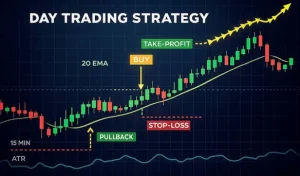
A common structure uses the 4H or 1H chart for overall trend, 15M to spot setups, and 5M to refine entries — reading higher timeframes for context while executing lower cuts down on false signals. Most of the edge gets built before the market opens: checking the economic calendar, marking major support and resistance, noting the prior day’s high and low, and confirming the higher-timeframe trend.
The Core Strategies of Day Trading
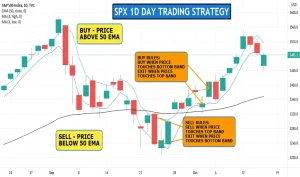
- Trend Following: Trade with the prevailing direction rather than guessing at reversals. EUR/USD holding above its prior daily high on the 1H — wait for a pullback to broken resistance: entry 1.12450, stop 1.12380 (7 pips), target 1.12590 (14 pips), a clean 1:2.
- Breakout: Works when price escapes a defined range with volume behind it. GBP/USD consolidating between 1.30220 and 1.30500, then breaking 1.30500 on a strong close with higher-timeframe alignment is a genuine breakout — not every push through a level is.
- Pullback: Enter after a retracement rather than at the high. NASDAQ 100 rallies from 22,100 to 22,260, then retraces to 22,180 where old resistance now acts as support — usually a tighter stop and better reward-to-risk than chasing the initial move.
- Range Trading: Best suited to sideways, lower-volatility days. Gold holding between $3,355 support and $3,380 resistance sets up buying near support and selling near resistance, skipping the middle where the payoff rarely justifies the risk.
- Momentum: Built around sharp moves following news or central bank decisions — USD/JPY rallying 95 pips in an hour after a strong jobs report. Demands fast, disciplined execution, since momentum can reverse as quickly as it appeared.
- VWAP-Based: Price holding above the session’s volume-weighted average price with pullbacks that keep holding above it suggests buyers remain in control. Far more reliable in centralized markets like stocks and futures than in Forex, where no consolidated volume figure exists.
Profitability of Day Trading Strategy
A strategy doesn’t need a high win rate to work. At a 45% win rate with 1:2 risk-to-reward (average win $200, average loss $100), 100 trades produce 45 wins ($9,000) against 55 losses (-$5,500) — a net of +$3,500. That’s why expectancy, not win rate, is what professional traders track. Position sizing follows the same logic: on a $20,000 account risking 1% ($200 max), a 20-pip stop on EUR/USD gets sized so that stop equals exactly $200 in loss — regardless of how confident the trade feels.
Final Thoughts about Day Trading Strategy
A real day trading strategy is a full framework — market analysis, execution rules, risk management, and psychological discipline working together, not a single indicator. Traders who last treat each trade as one data point in a larger sample, favor well-defined setups over chasing every move, and review performance over time rather than judging by the last trade. Whichever approach fits — trend, breakout, pullback, or range — the goal stays the same: a repeatable process that holds up as conditions change.
Source: Investopedia