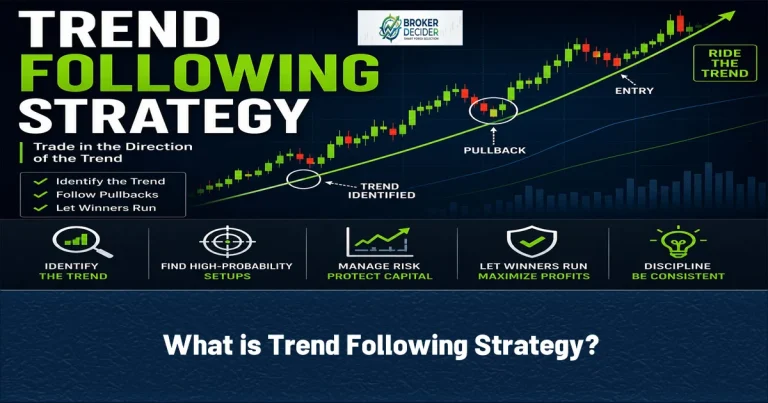
A trend following strategy is a trading method that seeks to profit by trading in the direction of an established market trend rather than trying to predict reversals. Instead of buying at the lowest price or selling at the highest, trend followers wait for confirmation that a trend exists and remain in the trade until objective evidence suggests the trend has ended.
Trend Following Strategy
Financial markets has two phases that are Trending markets and Ranging markets. A trend-following strategy is designed specifically for trending conditions. Identify an established trend, join it during a pullback or continuation, and remain in the trade while the trend stays intact. Unlike reversal trading, which attempts to anticipate turning points, trend following relies on confirmation. Traders allow the market to reveal its direction before risking capital. For example, if EUR/USD has been making higher highs and higher lows for several weeks, a trend follower looks for buying opportunities during pullbacks instead of trying to sell because the price appears expensive.
Why Trend Following Strategy is Useful?
Major financial trends are often driven by long-term economic forces rather than short-term speculation. Examples include Interest rate changes, Inflation trends, Central bank policies, Economic growth and Institutional capital flows. Because these factors usually develop over weeks or months, markets can remain in sustained trends for extended periods.
For instance, if the Federal Reserve begins lowering interest rates while inflation continues to ease, the U.S. dollar may weaken against several major currencies over time. A trend-following trader aims to participate in that broader movement instead of reacting to every intraday fluctuation.
Market Trends Types
Market Trends have different types that are:
Uptrend: An uptrend forms when price creates Higher highs (HH) or Higher lows (HL). For example Gold rises from $3,320 to $3,410 to $3,500 to $3,590. Each correction remains above the previous swing low, showing that buyers remain in control.
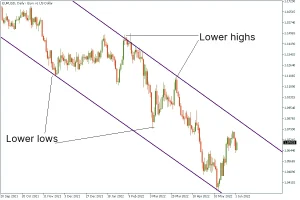
Downtrend: A downtrend occurs when price produces Lower highs (LH) or Lower lows (LL). For example USD/JPY falls from 149.20 to 148.10 to 147.30 to 146.40. Each rally fails below the previous swing high, indicating continued selling pressure.
Sideways Market
Not every market trends continuously. Sometimes price moves within a horizontal range where neither buyers nor sellers establish dominance. For example EUR/USD trades between “Resistance: 1.1780” and “Support: 1.1725” for several days. Trend-following strategies generally perform poorly in these conditions, so many traders wait until a clear trend develops.
Identifying a Trend
Professional traders rarely rely on a single indicator. Instead, they combine several forms of analysis that are:
- Market Structure: Market structure remains one of the most reliable methods. As long as the sequences Bullish trend with Higher highs and Higher lows and Bearish trend with Lower highs Lower lows continues, many traders assume the trend remains.
- Moving Averages: Moving averages help filter short-term market noise. The most commonly used long-term averages include 50-day Moving Average, 100-day Moving Average and 200-day Moving Average. If price remains above a rising 200-day moving average, the broader trend is generally considered bullish. Moving averages should confirm price action rather than replace it.
- Multiple Timeframe Analysis: Professional traders examine several timeframes before entering a position. A common approach is Weekly (Identify the primary trend), Daily (Confirm direction) and 4-Hour (Find trading opportunities). rading in the direction of the higher-timeframe trend often produces more consistent results than focusing only on lower-timeframe charts.
Example of Trading with Trend Following
Suppose EUR/USD has remained in a bullish trend for nearly two months. Market observations are:
- Weekly chart: Higher highs and higher lows.
- Daily chart: Above the 200-day moving average.
- Four-hour chart: Pullback toward previous support.
So Trade plan can be:
- Entry: 1.1725
- Stop Loss: 1.1685
- Risk: 40 pips
- Target: 1.1815
- Potential Reward: 90 pips
- Risk-to-Reward Ratio: 1:2.25
Rather than chasing price after a strong rally, the trader waits for a controlled pullback before entering. This provides a more favorable balance between risk and potential reward.
Rules of a Trend Following
Successful trend following is based on discipline rather than prediction. Instead of trying to identify market tops or bottoms, traders follow objective rules that keep them aligned with the prevailing trend. The core rules of a trend following strategy are:
- Trade with the Primary Trend: Trade in the direction of the dominant trend.
- Wait for Pullbacks: Many beginners buy after large bullish candles because they fear missing the move. Professional traders often do the opposite—they wait for price to retrace toward support before entering.
- Let Winning Trades Run: Trend followers understand that major market trends often continue much longer than expected.
Indicators for Trend Following
Best Indicators for Trend Following are:
- Moving Averages: Moving averages are among the most widely used trend-following tools. Popular settings include 50-day MA, 100-day MA and 200-day MA. If price remains above a rising 200-day moving average, the long-term trend is generally considered bullish.
- Average Directional Index (ADX): The ADX measures trend strength rather than direction. General interpretation are Below 20 (Weak or ranging market) and Above 25 (Stronger trending conditions). For example, if EUR/USD breaks higher while ADX rises from 18 to 30, the increasing trend strength supports the bullish move.
- Market Structure: Many professional traders rely more on market structure than indicators. They ask questions such as “Are higher highs still forming? Are higher lows still respected? Has the previous swing low been broken?” As long as the answers support the trend, they remain aligned with it.
Entry Techniques in Trend Following Strategy
There is no single perfect entry method, but two approaches are especially common:
- Pullback Entry: This is the preferred method for many trend followers. Rather than entering after a strong rally, traders wait for price to retrace toward a previous support level before looking for confirmation. This often improves the reward-to-risk ratio while reducing emotional decisions.
- Breakout Entry: Some traders enter when price breaks above resistance during an established trend. For example: NASDAQ 100 trades between 23,200 and 23,500 for several sessions. A strong close above 23,500 may indicate that the broader uptrend is continuing. Breakout entries provide earlier participation but can also increase exposure to false breakouts.
Exit a Trend Trade; How and When?
A trend should not be exited simply because price pauses or experiences a normal correction. Instead, many traders exit when objective evidence suggests the trend has weakened. Common exit signals include:
- Breakdown of market structure.
- Lower highs after an uptrend.
- Higher lows failing in a downtrend.
- A trailing stop-loss being triggered.
- Fundamental changes that invalidate the original trade idea.
Trend Following Strategy vs. Breakout Strategy
Look at the table below to compare Trend Following Strategy and Breakout Strategy with each other:
| Features | Trend Following Strategy | Breakout Strategy |
| Typical Entry | Pullback within the trend | Break above resistance or below support |
| Main Risk | Trend reversal | False breakout |
| Objective | Trade with an existing trend | Enter when price breaks a key level |
| Best Market | Established trends | Consolidation before expansion |
Final Thoughts about Trend Following Strategy
A Trend Following Strategy is one of the most practical trading approaches because it focuses on following confirmed market direction rather than trying to predict turning points. By combining market structure, multiple-timeframe analysis, disciplined entries, and sound risk management, traders can participate in larger market moves while limiting downside risk. Although no strategy wins every trade, consistent execution, patience, and proper position sizing are what give trend-following traders a long-term statistical edge.
Source: Investopedia