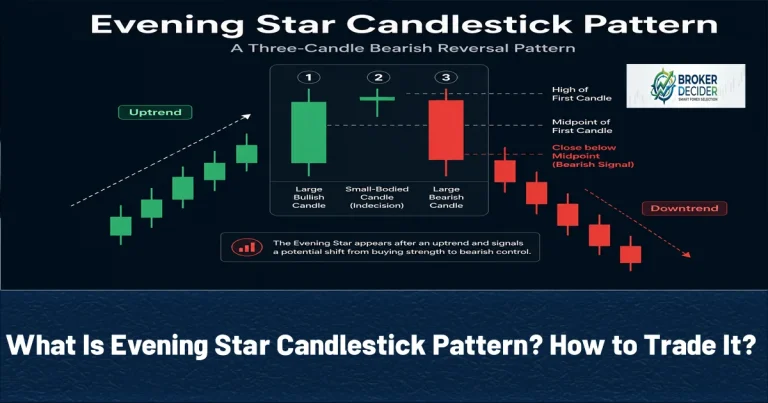
The Evening Star Candlestick is a three-candle bearish reversal pattern that typically develops after an established uptrend. Its structure moves from strong buying pressure to uncertainty and finally to a decisive bearish response. The Evening Star Candlestick pattern is considered the bearish counterpart of the Morning Star Candlestick Pattern. This pattern consists of:
- A large bullish candle
- A small-bodied candle
- A strong bearish candle
Evening Star Candlestick Pattern Formation
The first candle normally reflects the existing bullish trend. It has a relatively large body and closes higher, showing that buyers remain in control. The second candle is noticeably smaller. It may be bullish, bearish or resemble a Doji. Its importance comes from the loss of momentum rather than its color.
Buyers have pushed price higher, but they are no longer producing the same decisive movement. The third candle changes the character of the formation. A strong bearish candle indicates that sellers have entered with greater force and pushes price substantially lower, ideally closing below the midpoint of the first candle’s body. The textbook version often includes a gap around the middle candle. However, this condition is less practical as an absolute requirement in Forex because continuous trading means traditional gaps are less common than in many stock markets.
Read More: Best Forex Brokers in Afghanistan: Top 10 Brokers in 2026
How to read The Evening Star Candlestick?
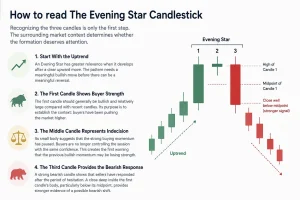
Recognizing the three candles is only the first step. The surrounding market context determines whether the formation deserves attention.
- Start With the Uptrend: An Evening Star has greater relevance when it develops after a clear upward move. If price has been producing higher highs and higher lows, buyers have demonstrated control. When the market then produces a small-bodied candle followed by a strong bearish candle, the formation suggests that this control may be weakening. On the other hand, finding an Evening Star in the middle of a sideways market does not carry the same meaning. The pattern needs a meaningful bullish move before there can be a meaningful reversal.
- The First Candle Shows Buyer Strength: The first candle should generally be bullish and relatively large compared with recent candles. Its purpose is to establish the context: buyers have been pushing the market higher. A strong bullish candle followed by hesitation creates a more recognizable change in momentum than three similarly sized candles moving sideways.
- The Middle Candle Represents Indecision: The middle candle is often the most interesting part of the pattern. Its small body suggests that the strong buying momentum has paused. A Doji or Spinning Top can appear here, but the candle does not have to be a perfect Doji. The important point is that buyers are no longer controlling the session with the same confidence. This does not mean that the reversal has already happened. It simply creates the first warning that the previous bullish momentum may be losing strength.
- The Third Candle Provides the Bearish Response: The third candle is where the potential reversal becomes much more significant. A strong bearish candle shows that sellers have responded after the period of hesitation. A close deep inside the first candle’s body, particularly below its midpoint, provides stronger evidence of a possible bearish shift. A weak bearish candle that barely moves below the middle candle is less convincing.
Location of The Evening Star Candlestick
An Evening Star forming close to a significant resistance level, previous swing high or other technical barrier can provide a stronger context for a potential reversal. For example:
Uptrend → Resistance → Evening Star → Bearish Confirmation
This tells a more complete story than simply finding three candles that happen to resemble the pattern.
Read More: What is Hanging Man Candlestick Pattern? How to Use it?
Trading With The Evening Star Candlestick Pattern
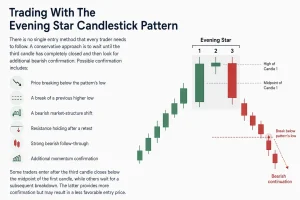
There is no single entry method that every trader needs to follow. A conservative approach is to wait until the third candle has completely closed and then look for additional bearish confirmation. Possible confirmation includes:
- Price breaking below the pattern’s low
- A break of a previous higher low
- A bearish market-structure shift
- Resistance holding after a retest
- Strong bearish follow-through
- Additional momentum confirmation
Some traders enter after the third candle closes below the midpoint of the first candle, while others wait for a subsequent breakdown. The latter provides more confirmation but may result in a less favorable entry price.
Stop-Loss and Take-Profit in The Evening Star Candlestick Pattern
For a bearish Evening Star setup, a stop-loss can be considered above a relevant invalidation point, such as the pattern high or a nearby swing high. The exact placement should depend on market structure and volatility rather than an arbitrary number of pips. Potential profit targets can include:
- The next support level
- A previous swing low
- A predefined risk-to-reward ratio
- A trailing-stop method
For example, if a trader risks 40 pips and targets twice that amount, the theoretical target would be 80 pips. However, nearby support should always be considered before selecting a target.
Read More: What is Shooting Star Candlestick Pattern? How to Use it?
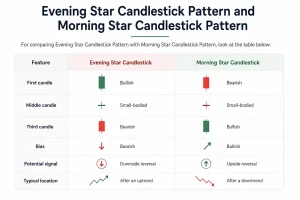
Evening Star Candlestick Pattern and Morning Star Candlestick Pattern
For comparing Evening Star Candlestick Pattern with Morning Star Candlestick Pattern, look at the table below:
| Feature | Evening Star Candlestick | Morning Star Candlestick |
| First candle | Bullish | Bearish |
| Middle candle | Small-bodied | Small-bodied |
| Third candle | Bearish | Bullish |
| Bias | Bearish | Bullish |
| Potential signal | Downside reversal | Upside reversal |
| Typical location | After an uptrend | After a downtrend |
Conclusion about Evening Star Candlestick Pattern
The Evening Star Candlestick Pattern tells a straightforward market story: buyers push price higher, momentum becomes uncertain, and sellers eventually respond with strength. But the pattern should not be treated as an automatic short signal. Its usefulness increases when the formation appears after a clear uptrend and around meaningful resistance or market-structure levels. Waiting for the third candle to close and looking for additional confirmation can also help traders avoid reacting to an incomplete setup.
Read More: What is Hammer Candlestick Pattern? How to Use it?
Visit Broker Decider Reddit page for more information.
Source: Investopedia