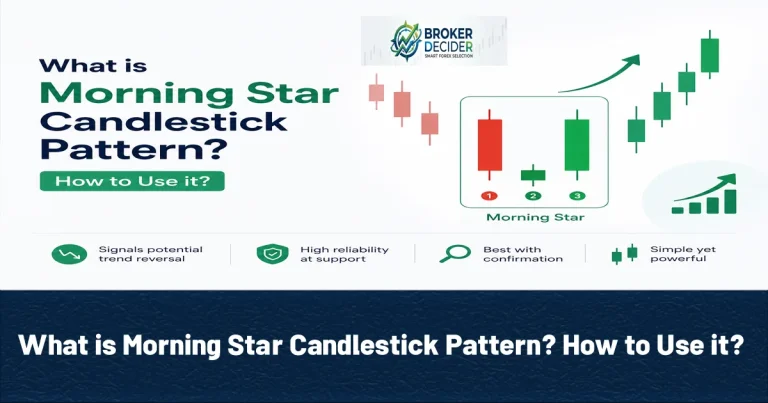
Morning Star Candlestick Pattern; Markets rarely turn around with a single candle that suddenly announces a new trend. More often, the shift happens gradually. Selling pressure starts to lose momentum, price hesitates, and buyers eventually begin to push back. The Morning Star Candlestick Pattern is designed to capture this kind of transition. A Morning Star is a three-candle bullish reversal pattern that typically appears after a sustained decline. Its structure reflects a change in market psychology: sellers dominate initially, uncertainty appears in the middle, and buyers finish the sequence with a stronger move higher. That progression is more important than simply memorizing the shape of three candles.
Morning Star Candlestick Pattern
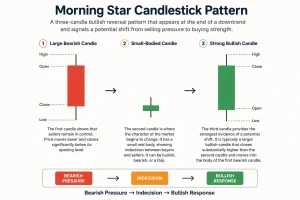
Morning Star consists of three candles that are:
- A large bearish candle: The first candle shows that sellers remain in control. Price moves lower and closes significantly below its opening level.
- A small-bodied candle: The second candle is where the character of the market begins to change. It has a relatively small real body, indicating that neither buyers nor sellers have achieved clear control. Depending on market conditions, this candle can be a small bullish or bearish candle, or it can resemble a Doji.
- A strong bullish candle: The third candle provides the strongest evidence of a potential shift. It is typically a larger bullish candle that closes substantially higher than the second candle and moves into the body of the first bearish candle.
So the structure is: Bearish Pressure → Indecision → Bullish Response
Read More: Best Forex Brokers in Afghanistan: Top 10 Brokers in 2026
A large bearish candle
The first candle should generally reflect the existing bearish trend. A relatively large bearish body shows that sellers have been able to move price lower with conviction. The stronger the preceding decline and the more clearly the first candle fits the existing structure, the more meaningful the overall formation can become. However, candle size should not be judged in isolation. A very large candle caused by a sudden news event does not automatically create a high-quality Morning Star setup.
A small-bodied candle
The middle candle is the turning point of the formation. Its small body suggests that the previous selling pressure has encountered hesitation. It can take several forms, including a small-bodied candle or a Doji. Traders should not focus excessively on whether the middle candle has a specific color. Its main role is to demonstrate uncertainty after the previous bearish move.
A strong bullish candle
The third candle is where buyers need to demonstrate meaningful strength. A strong bullish candle suggests that the market is no longer behaving like it did during the preceding decline. Ideally, it closes well into the body of the first bearish candle. A stronger recovery generally provides more convincing evidence than a weak bullish candle that barely moves above the middle candle. Still, the third candle does not guarantee that a reversal will follow.
Read More: What is Hanging Man Candlestick Pattern? How to Use it?
Importance of Morning Star Candlestick Pattern
The pattern is essentially a visual representation of changing market sentiment. Imagine a currency pair that has been falling for several sessions. Sellers have repeatedly pushed the market lower, and bearish candles dominate the chart. Then the selling move slows down. The next candle has a small body. Price may still move in both directions, but neither side manages to create a decisive close. Then buyers return with enough strength to produce a substantial bullish candle. The important development is not the three candles individually. It is the change in balance between sellers and buyers. The Morning Star therefore becomes more interesting when it appears at a location where a reversal would make technical sense.
Location and Appearance in Morning Star Candlestick Pattern
A Morning Star appearing randomly in the middle of a sideways market is generally less interesting than one forming around a meaningful support zone. For example:
Downtrend → Support → Morning Star → Bullish Confirmation
This combination gives traders more context than the candlestick pattern alone. Other factors such as previous swing lows, demand zones, trend structure and volume can also help determine whether the pattern deserves attention. The Morning Star should therefore be treated as a potential reversal setup, not an automatic buy signal.
Read More: What is Shooting Star Candlestick Pattern? How to Use it?
Reading the Morning Star Candlestick Pattern
Spotting three candles that resemble a Morning Star is easy. Deciding whether the formation actually matters is more difficult. The key is to stop looking at the pattern as an isolated shape and instead ask a broader question: What was happening before these three candles appeared, and what is price doing around them?
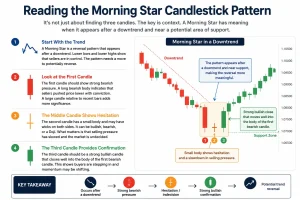
- Start With the Trend: A Morning Star is traditionally associated with a downtrend. If price has been making lower lows and lower highs, sellers clearly have the upper hand. A three-candle formation that then shows hesitation followed by a strong bullish response can be more meaningful. If the same formation appears inside a flat, directionless range, its reversal implications are considerably weaker. The pattern needs a move to potentially reverse in the first place.
- Look at the First Candle: The first candle should normally reflect strong bearish pressure. A long bearish body tells us that sellers were able to push price lower during that session. If the candle is unusually small, the formation may not provide the same clear transition from bearish control to indecision. It is also worth comparing the candle with those around it. A candle that is large relative to recent price action can make the shift in momentum easier to recognize.
- The Middle Candle Shows Hesitation: The middle candle is often the most visually distinctive part of the formation. It has a small body and may have noticeable wicks. A Doji can appear here, but a perfect Doji is not required for every valid Morning Star interpretation. What matters is that the aggressive selling seen in the first candle appears to have slowed. This is the point where traders should become interested, rather than immediately entering a position.
- The Third Candle Provides Confirmation: The third candle should demonstrate a meaningful return of buying pressure. A strong bullish close that penetrates a substantial portion of the first candle’s bearish body is generally more convincing than a weak bullish candle.
Support; Morning Star Candlestick
Location can dramatically change the quality of the setup. Suppose GBP/USD has been declining toward a previous swing low. Price reaches that area and forms a Morning Star. Now traders have several pieces of information:
- The market was already declining
- Price reached a potentially important support area
- Selling pressure became less decisive
- Buyers produced a strong response
This does not guarantee a reversal, but it creates a more logical bullish scenario than a Morning Star appearing without any nearby technical level.
Read More: What is Hammer Candlestick Pattern? How to Use it?
Additional Evidence of Morning Star Candlestick; Volume
For markets where reliable volume data is available, traders may also examine volume around the pattern. Increasing volume during the bullish third candle can provide additional evidence that participation has increased. However, Forex traders should be careful when interpreting volume because spot Forex is a decentralized market and commonly available platform volume is often tick volume rather than centralized exchange-traded volume. Therefore, volume should be treated as supporting information rather than a mandatory requirement.
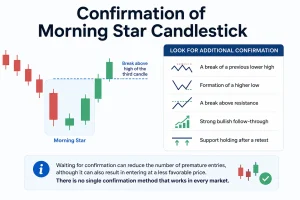
Confirmation of Morning Star Candlestick
Some traders prefer to wait for price to break above the high of the third candle before considering an entry. Others look for additional evidence such as:
- A break of a previous lower high
- Formation of a higher low
- A break above resistance
- Strong bullish follow-through
- Support holding after a retest
Waiting for confirmation can reduce the number of premature entries, although it can also result in entering at a less favorable price. There is no single confirmation method that works in every market.
Read More: What is Doji Candle? How to Use it?
less convincing Morning Star Candlestick Pattern
Even a textbook-looking Morning Star can fail. The pattern becomes less convincing when:
- It forms in the middle of a strong bearish trend without support
- The third candle is weak
- Price immediately falls below the pattern
- Major resistance is located directly above the entry
- The market is reacting to unexpected fundamental news
- The broader market structure remains strongly bearish
Morning Star Candlestick Pattern Trading Strategy
The Morning Star Candlestick Pattern becomes more practical when it is treated as the starting point of a trading setup rather than the entire setup. A simple approach is to wait for the three-candle formation, assess its location, and then look for evidence that buyers are actually gaining control.
Read More: What is Engulfing Pattern? How to Use it?
Entry With The Morning Star Candlestick Pattern After Confirmation
One conservative approach is to wait for price to move above the high of the third bullish candle. For example:
Downtrend → Support → Morning Star → Break Above Third Candle High → Entry
This approach gives the market an opportunity to confirm the bullish idea before the trade is opened. A more aggressive trader may enter near the close of the third candle, but that approach provides less confirmation and can expose the position to a failed reversal. Neither method is automatically superior. The choice depends on the trader’s risk tolerance and strategy.
Stop-Loss in Morning Star Candlestick
The stop-loss should be placed at a level that invalidates the trading idea rather than at an arbitrary number of pips. For a bullish Morning Star setup, traders may consider placing the stop:
- Below the low of the Morning Star formation
- Below the relevant swing low
- Below a nearby support zone
The exact location depends on market structure and volatility. A stop that is too close can be triggered by ordinary market fluctuations. A stop that is excessively wide can create an unnecessarily large position risk.
Take-Profit in Morning Star Candlestick
There are several ways to determine a potential profit target. A trader could use:
- The next resistance level
- A previous swing high
- A predefined risk-to-reward ratio
- A trailing-stop approach
- A combination of these methods
For example, if the trade risks 30 pips and the trader uses a 1:2 risk-to-reward target, the theoretical target would be 60 pips from the entry. However, technical structure should take priority. There is little benefit in targeting a fixed ratio if major resistance is sitting directly in the way.
Market Structure and Morning Star Candlestick
One of the stronger ways to use the pattern is to combine it with a change in market structure. Suppose price has been creating:
Lower High → Lower Low → Lower High → Lower Low
A Morning Star forms around the latest low, followed by a bullish move that breaks the previous lower high. Now the trader has more than a candlestick pattern. There is also evidence that the previous bearish structure may be weakening. This type of confirmation can be more meaningful than simply buying every Morning Star that appears.
Final Thoughts about Morning Star Candlestick
The Morning Star Candlestick Pattern is valuable because it tells a simple story: sellers were initially in control, that control weakened, and buyers eventually responded. But the three candles are only the beginning. A stronger trading decision comes from combining the pattern with market structure, support and resistance, confirmation and disciplined risk management.
Visit Broker Decider Reddit page for more information.
Source: Investopedia