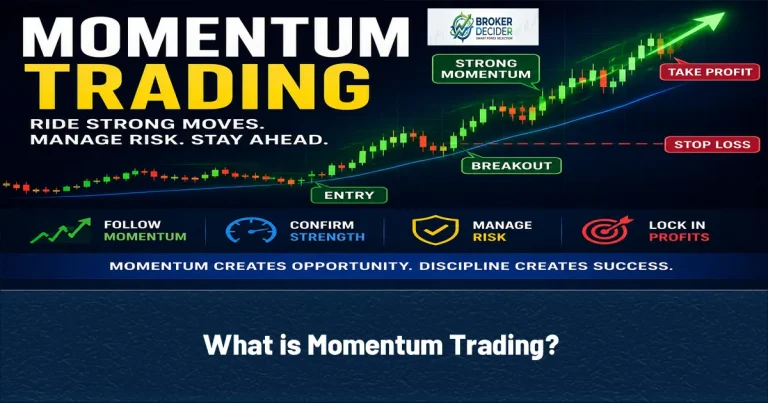
Momentum Trading is a forex trading strategy that enter to a position when there is a strong price movement and exit when that movement begins to weaken. Traders search for markets moving quickly in one direction, supported by increasing participation, strong price closes, or momentum indicators.
What traders look for in Momentum Trading strategy
Traders usually look for the things below for trading with Momentum Trading:
- Higher highs and higher lows
- Strong candles that are bullish
- Price closing near the top of its recent range
- Increasing trading activity
For example, if EUR/USD rises from 1.0800 to 1.0920 in two trading sessions, breaks above a previous high at 1.0900, and continues closing near its highs, the market may show bullish momentum. A Momentum Trading strategy would look for a controlled entry while defining the point where the momentum thesis becomes invalid.
The meaning of Momentum in Trading
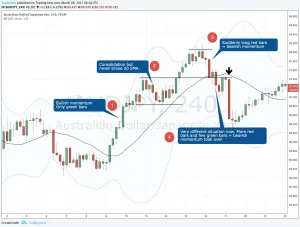
Momentum tells you about the speed and strength of price movement. A market can be moving upward but have weak momentum. For example, price may rise slowly over several days with small candles and frequent pullbacks. In contrast, a strong momentum move may produce large candles, consecutive closes in the same direction, and rapid breaks of important price levels.
Momentum Trading Evaluation
Momentum usually evaluated with:
- The size and direction of price candles
- The rate at which price reaches new highs or lows
- Breaks of support or resistance
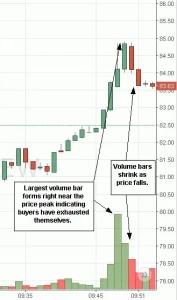
- Trading volume or market participation
- Indicators such as RSI, MACD, and ADX
Comparing Momentum Trading with Trend Following
| Features | Momentum Trading | Trend Following |
| Focus | Speed and strength of price movement | Direction of the trend |
| Entry | Strong breakout or momentum | Pullback in an established trend |
| Holding period | Minutes to days | Days to months |
| Risk | Momentum exhaustion | Trend reversal |
| tools | RSI, MACD, ADX, volume | Moving averages, market structure |
Comparing Momentum Trading with Breakout Trading
| Features | Momentum Trading | Breakout Trading |
| Focus | Strong and accelerating price movement | Price breaks a defined level |
| Entry | During strong continuation | At or after the break |
| Risk | Entering after exhaustion | False breakout |
| Confirmation | Momentum, price closes, volume | Breakout and possible retest |
Identifying Strong Momentum
For Identifying an Strong Momentum, follow the steps below:
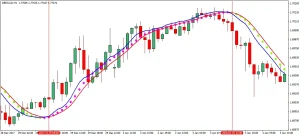
- Find Strong Price Closes: In a bullish momentum move, candles often close near their highs. In a bearish move, candles often close near their lows.
- Find Expansion in Price Range: Momentum often increases when current candles are larger than recent candles.
- Find Breaks With Follow-Through: A strong momentum move often breaks an important level and continues beyond it.
- Find Increasing in Participation: In markets with reliable volume data, stronger momentum may be supported by higher trading activity.
Entry Rules of Momentum Trading
For entering a position with Momentum Trading, follow the steps below:
- Identify a strong directional movement
- Mark the recent breakout
- Confirm momentum using price action and indicators
- Avoid entering after an unusually extended candle
- Define the stop-loss, target, and position size
Example: EUR/USD:
EUR/USD trades below 1.0900 and then breaks higher. So:
- Previous resistance: 1.0900
- Breakout: 1.0930
- Entry: 1.0935
- Stop Loss: 1.0905
- Profit Target: 1.0995
- Risk: 30 pips
- Potential Reward: 60 pips
- Risk-to-Reward: 1:2
Useful Indicators in Momentum Trading
Useful Indicators in Momentum Trading are:
- RSI: RSI measures the speed and magnitude of recent price changes on a scale from 0 to 100.
- MACD: MACD compares two exponential moving averages and is commonly used to evaluate momentum changes.
- ADX: ADX measures trend strength but does not indicate direction.
Stop-Loss and Profit Targets in Momentum Trading
A stop-loss should be placed where the momentum setup is no longer valid. For bullish trades it can be Below the breakout level, Below the most recent higher low or Below the low of the confirmation candle. Also, for bearish trades stop-loss can be Above the broken support level, Above the most recent lower high or Above the high of the confirmation candle.
About Profit Targets, exit rules are A fixed risk-to-reward target, such as 1:2, The next major support or resistance level, A trailing stop below higher lows or above lower highs or Closing when momentum weakens significantly.
Final Thoughts about Momentum in Trading
Momentum Trading try to capture strong price movement while momentum remains active. The strongest setups generally combine a clear directional move, a meaningful breakout or continuation pattern, strong price closes, and confirmation from momentum tools.
Source of “What is Momentum Trading?” Article: Investopedia