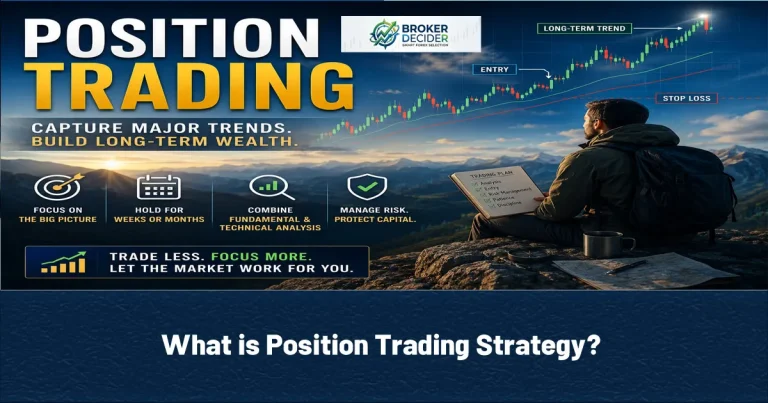
Position trading means holding trades for weeks, months, or occasionally years to capture major market trends rather than short-term price swings. Instead of reading five-minute candles, position traders build their thesis around economic cycles, central bank policy, and higher-timeframe technical, then stay in the trade as long as that thesis holds. Unlike day traders, position traders don’t close out before the session ends. They hold through multiple sessions, weekends, and news cycles, accepting short-term volatility in exchange for a shot at a much larger move.
What is Position Trading Strategy?
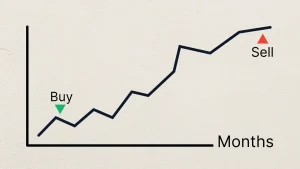
A typical position trade stays open for several weeks, several months, and occasionally more than a year. The goal isn’t calling every wiggle in price. It’s identifying a strong trend early and staying with it while the trend stays intact. Say a trader believes the Federal Reserve is entering a sustained rate-cutting cycle that will weaken the dollar over the next year. Rather than running dozens of short EUR/USD trades trying to time each Fed meeting, they open one long-term position and manage it over months as the macro trend plays out. That’s the core philosophy: Focus on the larger trend, and let the short-term noise be someone else’s problem.
Position Trading Strategy and other Trading Styles
Look at the table below and compare other Trading Styles with Position Trading Strategy:
| Strategy | Typical Hold | Objective | Overnight Exposure |
| Position Trading | Weeks to months or longer | Major market trends | Yes |
| Swing Trading | Days to weeks | Medium-term trends | Yes |
| Day Trading | Minutes to hours | Intraday opportunities | No |
| Scalping | Seconds to minutes | Small price moves | No |
Markets for Position Trading
- Forex: Major pairs — EUR/USD, USD/JPY, GBP/USD, USD/CHF, AUD/USD — trend for extended periods on interest rate differentials, inflation divergence, and central bank policy.
- Stocks: Position traders lean on fundamentals here more than anywhere else.
- Commodities: Gold, silver, crude oil, and natural gas develop extended trends on supply and demand shifts, geopolitical events, and shifting production levels.
- Stock Indices: S&P 500, NASDAQ 100, Dow Jones, and DAX 40 tend to reflect full economic cycles rather than daily noise, which makes them well suited to a longer hold.
Styles for Position Trading
Styles for Position Trading are:
- Trend Following: Trade with the primary trend until there’s objective evidence it’s changed — don’t try to call the top or bottom.
- Higher-Timeframe Breakouts: Instead of watching 5-minute ranges, position traders track weekly or monthly consolidation.
- Moving Average Trend: The 50-day, 100-day, and 200-day moving averages serve as a reference for whether the broader trend is intact — not an automatic signal.
- Fundamental Trend: If the Fed begins a sustained easing cycle while the ECB holds rates relatively higher, capital gradually rotates toward euro assets over the following months. The trade here isn’t reacting to each data print — it’s tracking whether the underlying macro narrative that justified the position in the first place is still true.

Worked Example of using Position Trading
EUR/USD:
Eurozone inflation stabilizes, U.S. rate expectations start declining, and European data improves. On the weekly chart, price retraces to 1.1500 — old resistance now acting as support.
Entry: 1.1510 | Stop: 1.1320 (190 pips risk) | Target: 1.2050 (540 pips reward) | Risk-to-reward: roughly 1:2.8
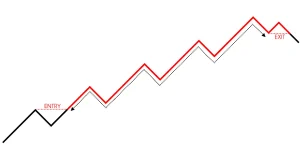
The trade stays open as long as the macro thesis and the weekly trend both keep pointing the same direction — short-term pullbacks along the way are expected, not a reason to exit.
Gold:
Central banks step up gold purchases, real interest rates decline, and safe-haven demand strengthens. Price breaks above long-term resistance at $3,500, confirmed on the weekly chart.
Entry: $3,520 | Stop: $3,360 ($160 risk) | Target: $3,900 ($380 reward) | Risk-to-reward: roughly 1:2.4
Again, the decision to stay in hinges on whether the broader macro backdrop remains supportive — not on what the daily candle did yesterday.
Conclusion about Position Trading
Position trading is built for capturing substantial trends rather than reacting to daily noise. Decisions get built around long-term technical structure, macro conditions, and disciplined risk management rather than the next candle. It demands patience and strict position sizing, since trades stay open through multiple news cycles and periods of real volatility.
Source: Investopedia