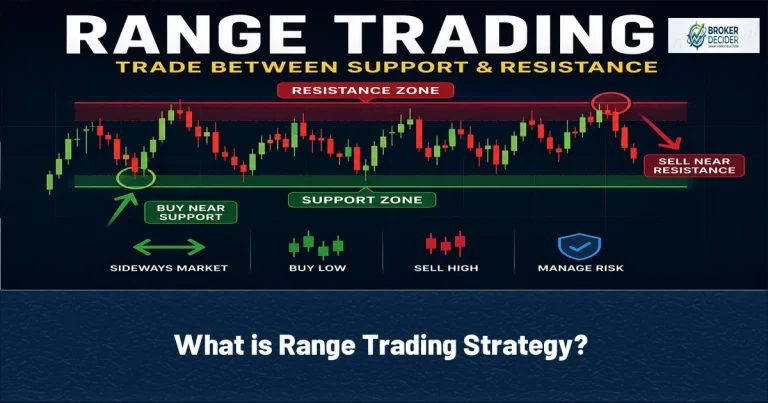
Range Trading is a strategy used when price moves repeatedly between a defined support zone and resistance zone without forming a sustained trend. Traders generally look to buy near support and sell near resistance, then place a stop-loss outside the range. For example, if EUR/USD repeatedly falls toward 1.1700 and rises toward 1.1800, the range is approximately 100 pips wide. A trader may look for a long entry near 1.1710 after bullish confirmation or a short entry near 1.1790 after bearish confirmation. The strategy remains valid only while price respects both boundaries. A strong breakout can invalidate the range setup.
What is Range Trading Strategy?
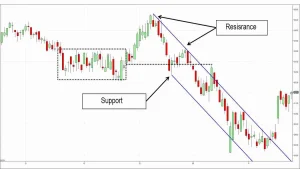
A range-bound market develops when buyers and sellers are relatively balanced. Instead of producing a clear sequence of higher highs and higher lows or lower highs and lower lows, price repeatedly changes direction inside a horizontal area. A trading range has three main zones:
- Support: The lower area where buyers have repeatedly entered.
- Resistance: The upper area where sellers have repeatedly entered.
- Midpoint: The center of the range, where new entries often offer weaker risk-to-reward ratios.
Finding correct Trading Range
In order to find a correct Trading Range, follow the steps below:
- Price has reacted near the upper boundary at least two times.
- Price has reacted near the lower boundary at least two times.
- Neither side has produced sustained follow-through outside the range.
- Market structure is mostly horizontal rather than clearly trending.
- Price repeatedly returns toward the center after testing a boundary.
For example, GBP/USD may trade between 1.2700 and 1.2800 for several days. If price repeatedly rejects both areas and returns toward the middle, the range is becoming more clearly defined. However, repeated tests can also weaken support or resistance. A range with several tests is not guaranteed to continue indefinitely.
Comparing Range Trading and Trend Trading
| Features | Trend Trading | Range Trading |
| Main objective | Follow momentum | Trade between boundaries |
| Main assumption | Trend continues | Range continues |
| Main risk | Reversal | Breakout |
| Typical entry | During pullbacks | Near support or resistance |
| Market condition | Directional | Sideways |
Key Areas in Range Trading Strategy
- Support: Support is an area rather than always one exact price. If EUR/USD repeatedly finds buyers between 1.1695 and 1.1710, traders may treat the entire area as a support zone.
- Resistance: Resistance is the upper area where selling pressure repeatedly appears. If GBP/USD repeatedly reverses between 1.2790 and 1.2810, that area may act as resistance.
- Midpoint: The midpoint is often the least attractive area for new entries because the potential reward is smaller and price can move in either direction.
Range Trading Strategy: Buying and selling
Range Trading Strategy can determine Buying and selling positions:
Buying in Range Trading Strategy
When a trader observe these signals, opening a trading position can be a good choice:
- Price reaches established support.
- A bullish rejection or engulfing candle forms.
- Selling momentum slows.
- Price breaks above a recent short-term high.
Selling in Range Trading Strategy
When a trader observe these signals, closing a trading position can be a good choice:
- Price reaches resistance.
- A bearish rejection candle appears.
- Buying momentum weakens.
- Price breaks below a short-term swing low.
Indicators for Range Trading Strategy
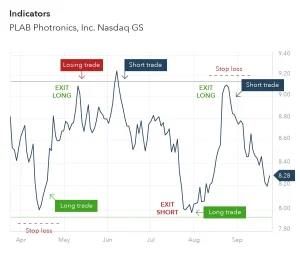
Indicators that are useful for Range Trading Strategy are:
- RSI: The Relative Strength Index can help identify short-term extremes. Above 70: Potentially overbought and Below 30: Potentially oversold. If price reaches range resistance while RSI is above 70, the signals may support a possible short trade.
- Bollinger Bands: In a stable range. Price may approach the lower band near support, Price may approach the upper band near resistance and The middle band can provide a reference for the range midpoint. A close outside a Bollinger Band does not guarantee a reversal. It may signal expanding volatility before a breakout.
- ADX: ADX measures trend strength rather than direction. As a general reference, Below 20: Weak trend conditions and Above 25: Stronger directional conditions. A low ADX can support the observation that the market is range-bound, but it does not guarantee that the range will continue.
Stop-Loss in Range Trading Strategy
A stop-loss should be placed beyond the point where the range idea is invalidated. For long trades, Below the support zone and Below the recent swing low. For short trades, Above the resistance zone and Above the recent swing high. Stops placed directly on support or resistance may be triggered by normal price fluctuations. Position size should be adjusted to match the stop distance rather than moving the stop closer simply to increase trade size.
Profit Targets in Range Trading Strategy
Common Range Trading targets include are The opposite side of the range, A level slightly before the opposite boundary, The range midpoint for a conservative target and A fixed risk-to-reward ratio. For example, a 30-pip stop with a 1:2 risk-to-reward ratio requires a target of approximately 60 pips.
Comparing Range Trading Strategy and Breakout Trading Strategy
| Features | Breakout Trading Strategy | Range Trading Strategy |
| Main expectation | Price moves beyond the range | Price stays inside the range |
| Entry | After a confirmed break | Near support or resistance |
| Target | Next major price level | Opposite boundary |
Final Thoughts about Range Trading
Range Trading is designed for sideways markets where price repeatedly moves between support and resistance. The strategy focuses on buying near the lower boundary, selling near the upper boundary, and avoiding low-quality entries near the midpoint.
Source: Investopedia