A pip in Forex is one of the most important concepts every trader must understand before entering the foreign exchange market. Whether you’re opening your first trade or developing a professional trading strategy, knowing how pips work is essential for measuring profits, losses, spreads, and risk.
Many beginner traders focus on currency prices without understanding how market movements are measured. However, nearly every aspect of Forex trading—from position sizing to risk management—depends on pips. In this guide, you’ll learn what a pip in Forex is, how it is calculated, how pip values work, and why pips play a critical role in successful trading.
Read More: What Is Forex Spread? One of the Most Important Trading Costs
What Is a Pip in Forex?
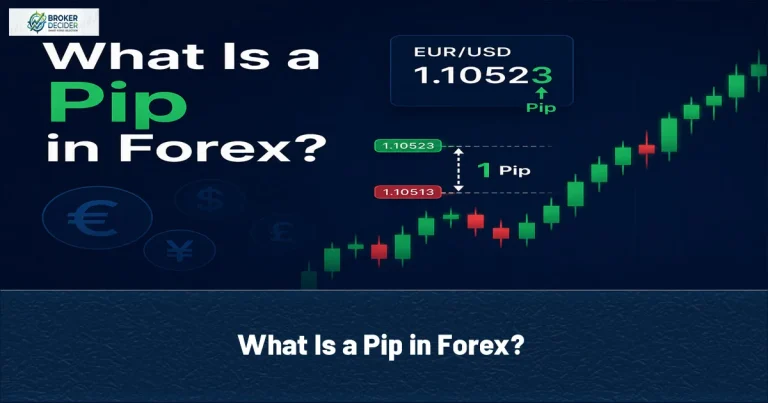
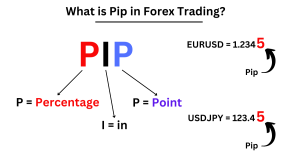
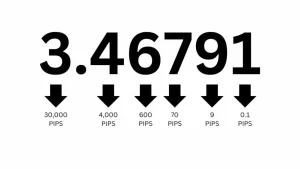
A pip in Forex stands for “Percentage in Point” or “Price Interest Point.” It is the standard unit used to measure price movements in currency pairs. For most currency pairs, a pip represents the fourth decimal place.
| Currency Pair | Price Movement | Pip Change |
| GBP/USD | 1.2500 → 1.2505 | 5 Pips |
| AUD/USD | 0.6700 → 0.6710 | 10 Pips |
| EUR/USD | 1.1000 → 1.1001 | 1 Pip |
When traders discuss market movement, they usually express it in pips rather than raw price changes. For instance, EUR/USD rises from 1.1000 to 1.1050. The market moved 50 pips higher. This standardized measurement makes it easier to compare movements across different currency pairs.
Why Is a Pip Important in Forex Trading?
Understanding a pip in Forex is crucial because pips are used to measure:
- Profit and loss
- Spread costs
- Stop-loss distances
- Take-profit targets
- Risk management
- Trading performance
Without understanding pips, traders cannot accurately calculate how much money they are risking or earning on a trade. For example, saying a trade gained “80 pips” is often more meaningful than simply discussing price changes.
Read More: Best Time to Trade Forex
How Does a Pip Work?
Let’s assume you buy EUR/USD at 1.1050 and The market then rises to 1.1075. The difference is 1.1075 − 1.1050 = 0.0025. This equals 25 pips. If your position size generates $10 per pip, your profit would be 25 × $10 = $250. This simple example shows why traders pay close attention to pip movements throughout the trading day.
Pip vs Pipette: What’s the Difference?
Modern brokers often quote currency prices with five decimal places instead of four. For example EUR/USD = 1.10505. In this case, A pip is 0.0001 and a pipette is 0.00001. A pipette is one-tenth of a pip. Most trading platforms automatically calculate pips and pipettes, but understanding the difference helps traders interpret market quotes correctly.
Read more: Forex Trading Psychology
Special Case: Japanese Yen Pairs
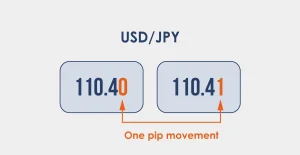
A pip in Forex is usually the fourth decimal place, but Japanese Yen (JPY) pairs work differently. For JPY pairs, a pip is generally the second decimal place. Because the Japanese Yen trades at a different numerical value, brokers use two decimal places instead of four when calculating standard pip movements.
| Currency Pair | Price Movement | Pip Change |
| USD/JPY | 145.50 → 145.53 | 3 Pip |
| EUR/JPY | 160.20 → 160.80 | 60 Pips |
How Much Is One Pip Worth?
The value of a pip depends on Currency pair, Trade size and Account currency. For most USD-denominated accounts trading USD-quoted major pairs:
| Position Size | Pip Value |
| Standard Lot (100,000) | Approximately $10 |
| Mini Lot (10,000) | Approximately $1 |
| Micro Lot (1,000) | Approximately $0.10 |
For example If you trade one standard lot of EUR/USD and the market moves 20 pips in your favor, $200 (20 × $10) is your profit. The same 20-pip move on a mini lot would generate approximately $20.
Read More: EUR/USD Forecast 2026
How to Calculate Pip Value
A simple formula often used to Calculate Pip Value is:
Pip Value = (One Pip / Exchange Rate) × Lot Size
For example, EUR/USD = 1.1000, Standard lot = 100,000 units and One pip = 0.0001. So pip Value is:
(0.0001 ÷ 1.1000) × 100,000 ≈ $9.09
Most modern trading platforms calculate pip values automatically, but understanding the calculation helps traders manage risk more effectively.
How Pips Affect Profit and Loss
Every Forex trade gains or loses value based on pip movement. Let’s look at an example. For a winning trade:
- Buy EUR/USD at 1.1000
- Sell at 1.1050
The result is 50 pips profit. With a standard lot, 50 × $10 = $500 profit.
For a losing trade:
- Buy GBP/USD at 1.2500
- Sell at 1.2470
The result is 30 pips loss. With a standard lot, 30 × $10 = $300 loss.
Read More: Best Forex Indicators in 2026
How Pips Help with Risk Management?
One of the most valuable uses of a pip in Forex is risk management. Suppose your trading plan allows a maximum risk of $100 per trade. If your stop-loss is 20 pips, then your position size should be adjusted so that 20 pips = $100 risk. This approach helps traders maintain consistent risk regardless of market conditions. Professional traders often calculate Risk per trade, Reward-to-risk ratio and Position size. using pip distances rather than arbitrary dollar amounts.
Common Mistakes Beginners Make with Pips
Many new traders misunderstand pips during their first months of trading. Common mistakes include:
- Ignoring Pip Value
- Confusing Pips and Points
- Risking Too Many Pips
- Focusing Only on Dollar Amounts
Read More: Forex Copy Trading in 2026
Conclusion; What Is a Pip in Forex?
Understanding what a pip in Forex is, forms the foundation of successful currency trading. A pip is the standard unit used to measure price changes, calculate profits and losses, evaluate spread costs, and manage risk.
Whether you’re trading EUR/USD, GBP/USD, USD/JPY, or any other currency pair, mastering pip calculations will help you make better trading decisions and understand market movements more clearly. As you gain experience, you’ll find that thinking in pips rather than dollars provides a more professional and consistent way to analyze your trading performance.
Source: Investopedia