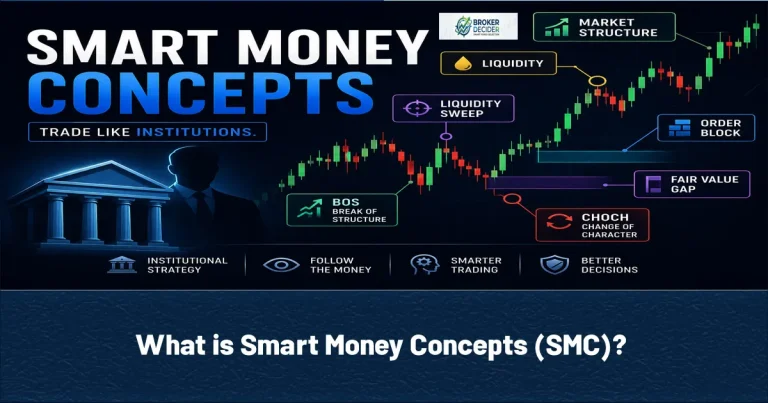
Smart Money Concepts (SMC) is a price action methodology built around understanding how large financial institutions actually interact with the market. Rather than leaning primarily on technical indicators, Smart Money Concepts pushes traders to study market structure, liquidity, institutional order flow, and price behavior in order to make more informed decisions.
What are SMC?
The idea at the heart of Smart Money Concepts is straightforward: institutional participants move the market in a meaningful way simply because of the sheer size of their orders. While retail traders often react to price after the fact, Smart Money Concepts tries to understand the conditions that likely caused those price movements in the first place. No trading methodology can predict the market with certainty, and Smart Money Concepts is no exception. What it does offer is a structured way to read price action through an institutional lens rather than a purely indicator-based one.
Why Smart Money Concepts are important?
Traditional technical analysis leans heavily on chart patterns and indicators, and while those tools remain genuinely useful, many traders feel they only tell part of the story. Smart Money Concepts puts the emphasis on market context instead. Rather than asking whether an indicator is flashing a buy or sell signal, SMC asks different questions entirely: where is liquidity sitting, who currently controls the market, has market structure changed, is price revisiting an area of imbalance, and could institutions be entering or exiting positions right now?
Principles of SMC
SMC covers a lot of ground, but a handful of concepts form its real foundation. Principles of SMC are:
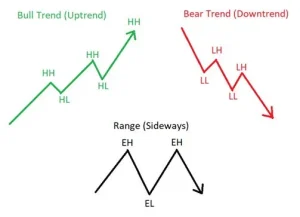
1. Market Structure
Market Structure lays out the overall framework of price movement. By tracking Higher Highs, Higher Lows, Lower Highs, and Lower Lows, traders can judge whether buyers or sellers currently hold control.
2. Liquidity
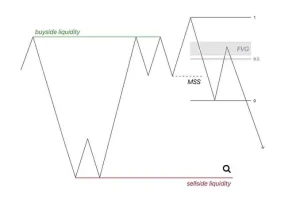
Liquidity is one of the most central ideas within Smart Money Concepts. It refers to areas where a large number of pending orders or stop-loss orders are likely clustered — previous highs and lows, equal highs and lows, trendline breakout areas, and session highs and lows. Many SMC traders believe price frequently gravitates toward these zones before making its next significant directional move.
3. Liquidity Sweep
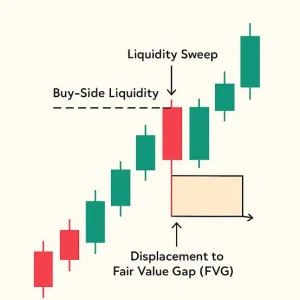
A Liquidity Sweep happens when price briefly pushes beyond a well-known support or resistance level, triggers the stop-loss orders sitting there, and then either reverses or continues on.
4. Order Blocks
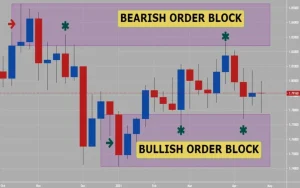
Order Blocks mark areas where institutional buying or selling activity is believed to have occurred right before a strong impulsive move. When price comes back to revisit these zones, traders watch closely for a reaction and an Order Block carries even more weight when it lines up with Market Structure and Liquidity.
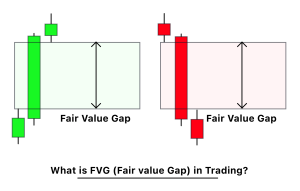
5. Fair Value Gaps (FVG)
A Fair Value Gap is a price imbalance created during a burst of strong momentum. Instead of trading every imbalance that appears, SMC traders typically wait to see whether price returns to rebalance the gap before continuing in its original direction, which makes FVGs a common pullback zone inside trending markets.
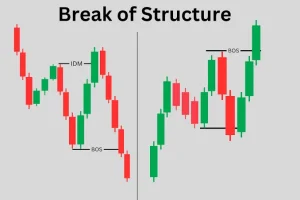
6. Break of Structure (BOS)
Break of Structure confirms that an existing trend is still intact. In an uptrend, a BOS occurs when price breaks above the previous significant swing high; in a downtrend, it occurs when price breaks below the previous swing low. BOS helps traders confirm continuation rather than guess at where price might go next.
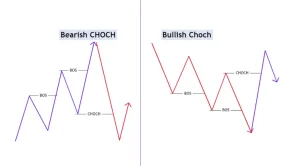
7. Change of Character (CHOCH)
Change of Character flags an early shift in market behavior. Unlike BOS, which confirms that a trend is continuing, CHOCH suggests that buying or selling momentum may be starting to change and most traders treat it as an early warning rather than outright confirmation of a new trend.
How to use Smart Money Concepts in forex trading?
Experienced traders layer several of Smart Money Concepts together. Starting with the higher timeframe Market Structure, locating nearby liquidity, waiting for a liquidity sweep, watching for a Change of Character, confirming with a Break of Structure, waiting for price to revisit an Order Block or Fair Value Gap, and only then looking for additional price action confirmation before entering. This layered approach is what builds real context, rather than leaning on any single technical signal in isolation.
Advantages and disadvantages CMS
| Advantages | disadvantages |
| Improves understanding of institutional behavior | learning curve is fairly steep |
| Focuses on price action rather than lagging indicators | There’s no guarantee institutions behave exactly as theorized |
| Works across multiple financial markets | False signals crop up during highly volatile conditions |
| Encourages structured, step-by-step market analysis | Mastering the framework takes real patience |
| Complements strong risk management practices | *** |
| Can be applied to different timeframes | *** |
SMC vs. Technical Analysis
| Smart Money Concepts | Technical Analysis |
| Uses price action as the primary tool | Often relies on technical indicators |
| Integrates multiple concepts together | Frequently analyzes one indicator at a time |
| Focuses on institutional behavior | Focuses on indicators and chart patterns |
| Encourages contextual analysis | Often focuses on isolated setups |
| Emphasizes liquidity and market structure | Emphasizes historical price signals |
Common Mistakes of trading with SMC
Common Mistakes of trading with SMC are:
- Ignoring higher timeframes
- Trading every liquidity sweep
- Skipping Market Structure
- Ignoring risk management
Conclusion about Smart Money Concepts or SMC
Smart Money Concepts (SMC) offer a structured way to read financial markets by focusing on market structure, liquidity, institutional behavior, and price action rather than relying solely on technical indicators. Smart Money Concepts takes real time and practice to master, but it offers a comprehensive framework that can sharpen chart analysis across Forex, stocks, indices, commodities, and cryptocurrencies.
Source: CoinMarketCap