If you’ve spent any time around ICT or Smart Money Concepts content, you’ve probably seen the London Kill Zone mentioned as the window where “the real move” happens. That reputation isn’t just trading folklore. It’s backed by how the market’s largest liquidity pool actually behaves once London wakes up.
The London Kill Zone is a narrow stretch of the London session, typically the first two to three hours after the market opens, when liquidity, order flow, and volatility jump sharply compared to the quiet overnight hours. It’s the window where institutional desks that have been sitting on orders since the Asian close start executing, where the previous night’s tight range often gets broken, and where a large share of the day’s directional move tends to get set.
What is London Kill Zone? (Quick Answer)
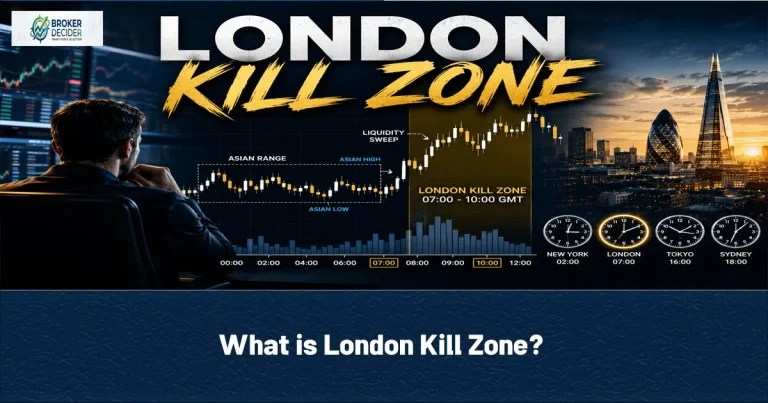
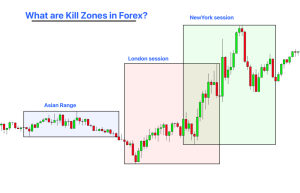
The London Kill Zone is the first high-liquidity window after the London Forex session opens, generally accepted as 07:00–10:00 GMT, though the exact boundary shifts by an hour during Daylight Saving Time transitions. Within this window, ICT traders watch for the Asian session’s overnight range to be swept, followed by the first strong directional push of the day.
London Session and London Kill Zone
New traders often use these two terms interchangeably, and that mix-up leads to a lot of wasted screen time waiting for “Kill Zone conditions” at 3 p.m. London time, long after the window has closed. The London Session is the full working day for London-based institutions. The London Kill Zone is a much smaller slice of that day, isolated because it’s when order flow tends to be most concentrated.
| No. | London Session | London Kill Zone |
| Hours | 08:00–17:00 GMT | 07:00–10:00 GMT |
| Duration | ~9 hours | ~2–3 hours |
| Status | Recognized Forex trading session | ICT / SMC trading concept |
| Scope | All market activity | The highest-liquidity opening stretch |
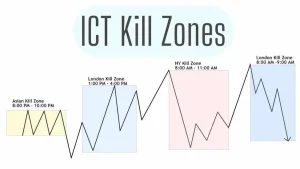
London Kill Zone Trading Hours
| Time Zone | London Kill Zone |
| GMT / UTC | 07:00–10:00 |
| New York (EST/EDT) | 02:00–05:00 |
Why the London Kill Zone is Important?
The importance of this window has nothing to do with the hour itself and everything to do with who shows up to trade during it.
According to the Bank of England’s summary of the 2025 BIS Triennial Central Bank Survey, published in September 2025, average daily foreign exchange turnover in the UK market reached $4.745 trillion in April 2025, up from $3.735 trillion in 2022. The UK held a 37.8% share of global FX turnover, essentially unchanged from 38.0% three years earlier and still comfortably the largest of any financial center worldwide — ahead of the United States, Singapore, and Hong Kong combined in relative weight.
Global daily FX turnover across all centers hit a record $9.6 trillion in the same survey, a 28% jump from 2022. That concentration of activity in one city is the entire reason the London open matters. When London’s desks come online, a large share of that multi-trillion-dollar daily flow starts moving through the market within a few hours, not spread evenly across the day.
The Asian Session Sets the Stage
You can’t really understand the Kill Zone without understanding what happens in the hours before it. Roughly between 00:00 and 07:00 GMT, European currency pairs generally see thinner participation from London and New York desks. With fewer large players active, price tends to consolidate rather than trend.
On a typical trading day, EUR/USD and GBP/USD often settle into an overnight range of roughly 20–40 pips — narrower on quiet days, wider around scheduled Asian-session data or risk events. In ICT terminology, the top and bottom of that range are labeled the Asian High and Asian Low, and they matter because retail and regional traders who took positions during the quiet hours tend to place stops just beyond those levels.
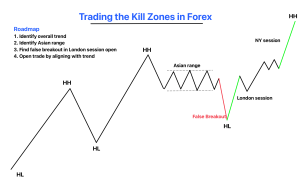
That clustering of stop orders is what ICT traders mean when they talk about “liquidity resting” above or below the range. When London opens and volume increases, price frequently pushes through one side of that range before the day’s real direction takes shape.
That doesn’t automatically mean manipulation, and it doesn’t guarantee a reversal — sometimes the breakout simply continues as a genuine trend. The Asian range is a reference point for where liquidity is sitting, not a signal on its own.
The London Open and Institutional Order Flow
Large institutions rarely dump their full order size into a thin market — doing so would move the price against them before the order is even filled. Instead, they tend to time execution around the deepest liquidity of the day, which is exactly what the London open provides: more participants, tighter spreads, and faster matching, all arriving at once.
EUR/USD, GBP/USD, and EUR/GBP typically show the clearest jump in activity in the minutes after London opens, which is why these three pairs get referenced constantly in Kill Zone discussions. Higher liquidity doesn’t hand you a profitable trade — it simply widens the range of realistic price movement you’re working with.
The Markets Move During the London Kill Zone
While the concept is discussed almost exclusively in a Forex context, its reach extends into anything closely tied to European trading hours.
| Currency pairs or Instrument | Typical Activity Level in the Kill Zone |
| GBP/USD | Very high |
| EUR/USD | Very high |
| GBP/JPY | High |
| EUR/JPY | High |
| EUR/GBP | High |
| XAU/USD | High |
| DAX / FTSE 100 CFDs | High |
| USD/CHF | Moderate |
ICT Concepts of the London Kill Zone
Understanding the window itself is only half the picture. The reason ICT traders built an entire methodology around it comes down to a handful of structural concepts that tend to show up here more reliably than at other times of day.
- Asian Range Liquidity: As covered above, the Asian session’s tight overnight range creates two clear reference levels — the Asian High and Asian Low — where resting orders accumulate. This range, usually 20–40 pips on EUR/USD and GBP/USD during normal conditions
- Liquidity Sweep: A liquidity sweep happens when price pokes just beyond a well-defined high or low — often by only a handful of pips — triggering the stop and pending orders clustered there before reversing or continuing.
- Judas Swing: The Judas Swing describes an early, sharp move in one direction shortly after the Kill Zone begins, which then reverses to become the day’s real trend.
- Market Structure Shift: Once liquidity has been taken on one side, traders look for the first sign that short-term direction is turning. If price has been printing lower highs and lower lows, sweeps the Asian High, and then breaks the most recent lower high, that break is commonly read as a Market Structure Shift.
- Break of Structure: A Break of Structure confirms that price has cleared a genuinely significant swing point, not just a minor pullback high.
- Change of Character: Where Break of Structure usually confirms a trend continuing, Change of Character flags a possible shift from one condition to another.
- Order Blocks: An Order Block is generally defined as the last opposing candle before a strong impulsive move.
- Fair Value Gaps: The speed of Kill Zone moves often leaves gaps where very little trading occurred between candles.
Spreads in London Kill Zone
Spreads and Execution Quality Tighter competition among liquidity providers during the Kill Zone generally means narrower spreads on the most liquid instruments — one of the more concrete, measurable benefits of trading this window rather than the thinner overnight hours.
| Currency pairs or Instrument | Spread in Low Liquidity | Spread in London Kill Zone |
| EUR/USD | 1.2–2.0 pips | 0.1–0.5 pips |
| GBP/USD | 1.5–2.5 pips | 0.3–0.8 pips |
| USD/JPY | 1.0–1.8 pips | 0.2–0.6 pips |
Final Thoughts about London Kill Zone
London Kill Zone lines up with the period when the world’s largest FX hub is at its most active. That concentration of institutional flow is what produces the liquidity sweeps, structure shifts, and stronger intraday moves this window is known for. None of that makes it a strategy on its own. It’s market context. A trade still needs to line up with the higher-timeframe trend, current structure, available liquidity, sound risk management, and awareness of what’s on the economic calendar that day.
Source: Investopedia